What Is an Exoskeleton? A Clear Guide
A practical taxonomy of wearable robots, passive support systems, consumer devices, workplace equipment and regulated medical exoskeletons.

Research standard: this guide draws on primary records, technical documentation and documented field experience. Volatile facts such as price, availability and firmware are reviewed on a dated schedule.

The useful definition
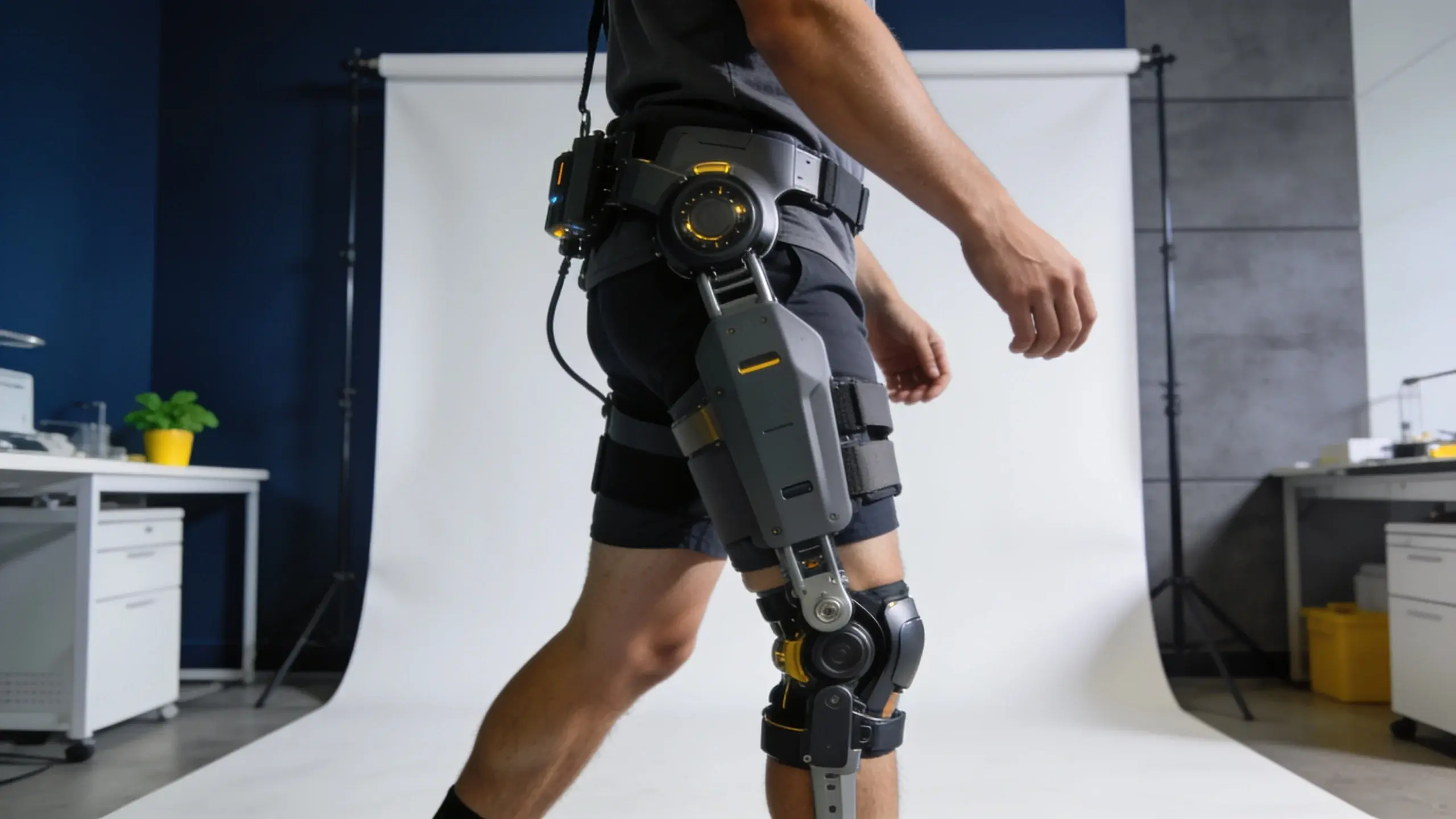
The broadest useful definition is a wearable system that transfers forces between a device and a person. That system may support a joint, redirect a load, resist a motion or add powered torque. It does not have to cover the whole body, look like armor or move for the wearer.
The interface is central. Cuffs, straps, belts and rigid links have to align with the wearer's body well enough to transmit assistance without creating a new problem. Fit, movement pattern and intended task therefore belong in every serious comparison.
Original identification map
Follow the physical assistance path
The label alone is incomplete. To identify the mechanism, trace the assistance source, the wearable force route, the contact points on the body and the movement or load it targets.
Assistance source
Powered or passive
Wearable route
Mechanism and structure
The device carries force through its structure or transmission. Depending on the design, that path may include rigid links, textiles or cables.
Physical interface
Contact and assisted target
Cuffs, orthoses, straps or sleeves couple the device to the wearer and transfer force to a defined joint, body region or supported load.
- 1. Source
What supplies or redirects the assistance?
- 2. Route
Which device structure carries the force?
- 3. Contact
Where does the system meet the wearer?
- 4. Target
Which movement, body region or load is assisted?
Four markets that should stay separate
| Class | Typical purpose | How ExoRank treats it |
|---|---|---|
| Consumer / recreational | Walking, hiking, travel or fitness assistance | Eligible for buyer guides when availability and evidence are verified |
| Occupational / industrial | Support for a defined workplace task | Assessed with task, training and risk-transfer context |
| Medical / rehabilitation | A clinical or personal-use medical indication | Regulator and clinical evidence required; no consumer ranking |
| Prototype / research | Demonstration or experimental study | Tracked as research, not presented as a purchasable option |
Five fields define an exoskeleton more precisely than its name
The word exoskeleton describes a broad family, not one mechanism. A useful record identifies the intended use, source of assistance, assisted body region, structural load path and function. Keeping those five fields separate prevents a powered recreational hip device, a passive shoulder support and a regulated gait-training system from being treated as direct alternatives.
| Field | Question to answer | Why it changes the comparison |
|---|---|---|
| Intended use | Consumer, occupational, medical or research? | It determines the evidence, access path and claims that are relevant |
| Power source | Powered, passive or hybrid? | It changes controls, energy logistics, failure behavior and maintenance |
| Body region | Which joint or segment receives force? | Hip, knee, ankle, back and shoulder systems act on different movements |
| Structure | Rigid, soft or hybrid load path? | It changes alignment, anchoring, motion freedom and how force reaches the body |
| Function | Assist, resist, support, stabilize or train? | Similar hardware can be configured for different tasks and outcomes |
Exoskeleton, exosuit and wearable robot are overlapping terms
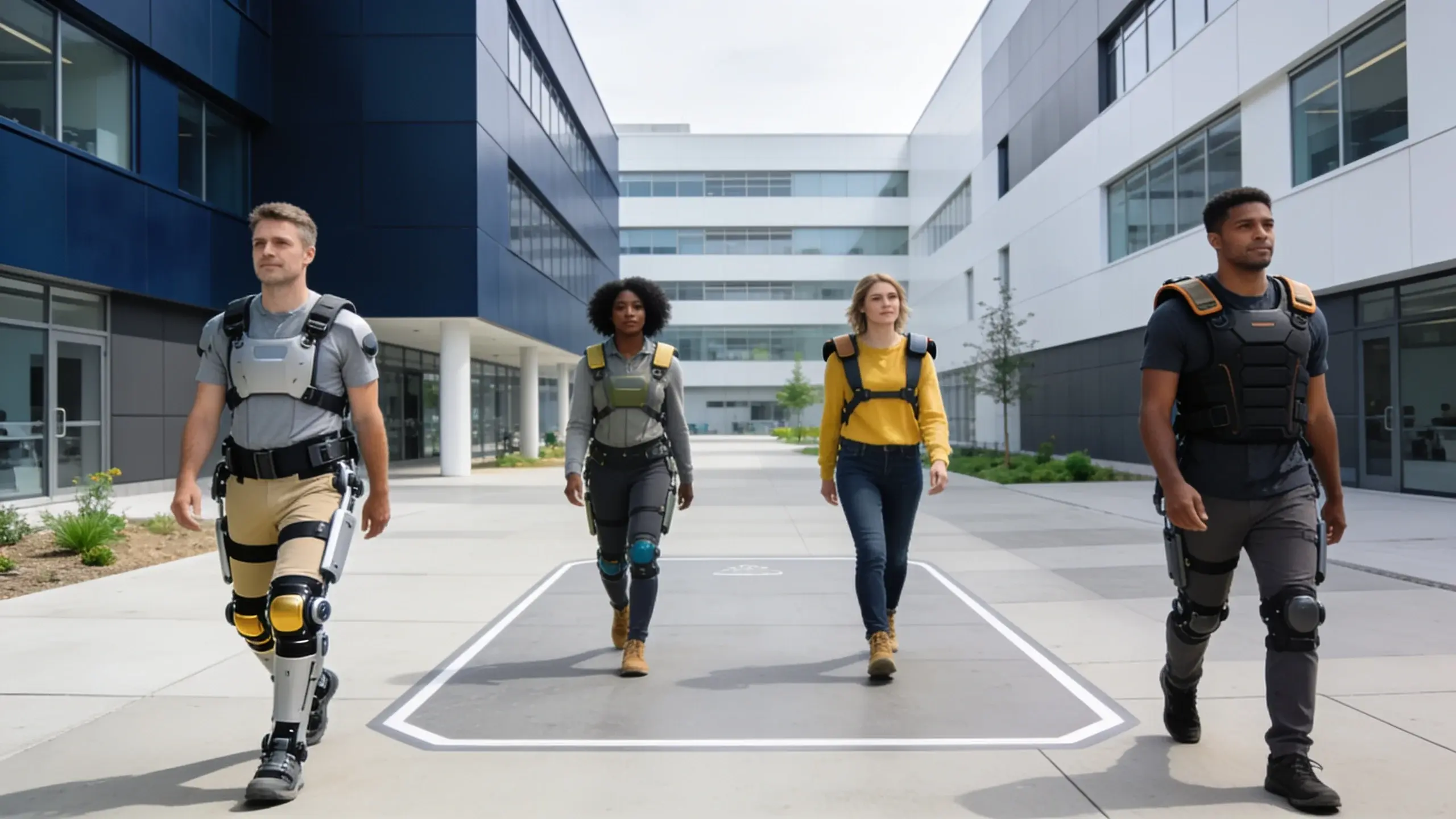
A rigid frame with joint-adjacent links is commonly called an exoskeleton. A textile system that routes tension through garments, straps or cables is often called an exosuit. Hybrid products combine rigid anchor pieces with flexible transmissions. Naming remains inconsistent, so structure should be described from the actual force path rather than inferred from a product label.
Powered does not mean autonomous
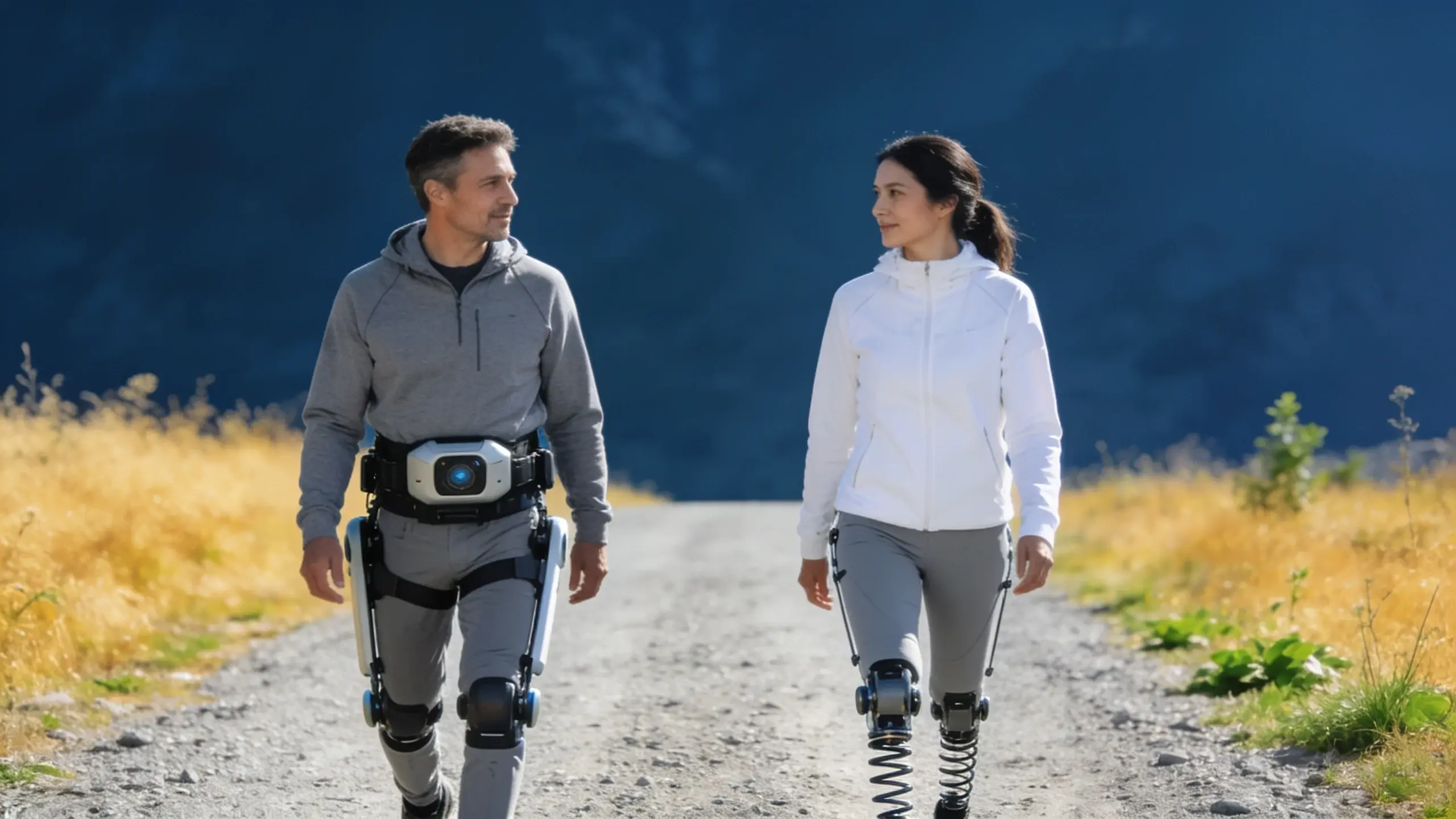
A powered consumer exoskeleton can sense motion and add assistance, but the wearer still controls balance, foot placement and route choice. Assistance may also feel different during continuous walking, slopes, starts, stops and transitions. A product's operating modes and rated output therefore do not establish one universal performance result.
How the human and the device form one mechanical system
Assistance is useful only when the device can react against another part of the body. A hip system may transfer force between a waist interface and thigh cuffs. A knee system commonly reacts between thigh and shank interfaces. A shoulder support may redirect arm load toward the torso. This reaction path explains why straps, cuffs, alignment and tissue compression are performance variables rather than secondary comfort details.
The biological joint and the device joint also do not behave as identical hinges. Human joints translate and rotate, while a rigid mechanism follows its own geometry. Soft structures reduce dependence on a mechanical hinge but introduce deformation and anchor movement. Exact-model evidence should therefore describe interfaces and adjustment ranges beside torque, power or assistance claims.
What an exoskeleton can and cannot establish
| A product record may establish | It does not establish by itself |
|---|---|
| The exact assisted body region and intended activity | That the product suits every person or movement within that activity |
| A manufacturer-rated power, torque, runtime or distance | A universal real-world performance result across users and terrain |
| A stated commercial or regulatory status in one market | Equivalent availability, indication or compliance in every jurisdiction |
| A study result for a named prototype and protocol | The same outcome for another model, population, speed or comparison baseline |
A practical identification sequence
- Name the exact model and generation rather than stopping at the brand.
- Identify the intended user and setting before reading performance claims.
- Trace which body segments the device touches and where reaction forces travel.
- Record powered or passive assistance, direction of assistance and relevant movement phase.
- Separate a purchasable product from a prototype, institutional system or discontinued generation.
- Attach every numerical claim to its unit, configuration, source and verification date.
How to read product language
- Identify the exact model and generation; brand-level feature lists often mix variants.
- Separate manufacturer-rated output or range from independently observed behavior.
- Check the assisted joint: hips and knees are not equivalent use cases.
- Confirm whether the device is consumer, occupational or medical before comparing claims.
Sources
- ASTM F3323-24: Standard Terminology for Exoskeletons and Exosuits
- ASTM Committee F48 on Exoskeletons and Exosuits
- ASTM F48.02 human factors and ergonomics standards
- NIOSH: Industrial Exoskeletons
- Journal of NeuroEngineering and Rehabilitation: physical-interface power transfer study (2017)
- FDA 510(k) record: ReWalk P6.0
Key facts
- Powered and passive exoskeletons create assistance in fundamentally different ways.
- Hip-assist, knee-assist, back-support and shoulder-support devices solve different movement problems.
- A consumer hiking product is not interchangeable with a regulated medical mobility device.
- ExoRank treats prototypes and unavailable demonstrators separately from products that can be ordered.
Frequently asked questions
Is an exoskeleton a robot?
Some powered exoskeletons are wearable robots, but the category also includes passive mechanical systems. The wearer remains part of the control and balance system.
Can anyone buy an exoskeleton?
Some consumer products are sold directly, while medical and workplace systems may require assessment, training, supervision or institutional procurement. Availability must be checked for the exact model and market.
Does an exoskeleton make you stronger?
Some devices add or redistribute force for a defined movement, but that does not translate into unlimited strength or suitability for every task. Use limits and evidence vary by model.