Types of Exoskeletons: Five Ways to Classify Them
Classify wearable systems by intended use, power source, body region, structure and function before comparing devices.

Research standard: this guide draws on primary records, technical documentation and documented field experience. Volatile facts such as price, availability and firmware are reviewed on a dated schedule.
The five classification axes
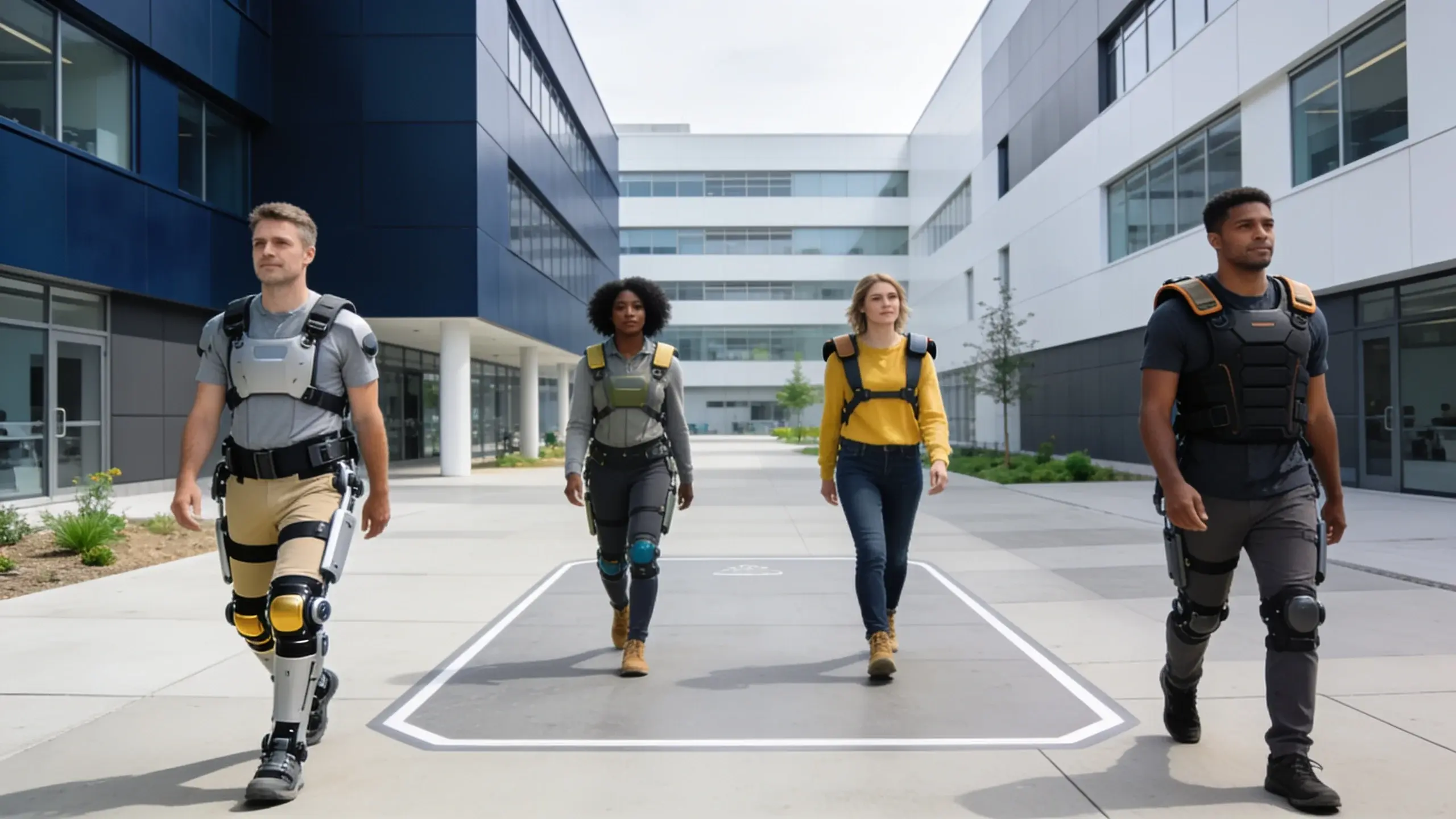
No single list can capture every exoskeleton type because power, structure, body target and intended use describe different properties. A useful classification records all five axes instead of forcing a device into one box. That keeps a structural label such as soft from being mistaken for a power source and a body-region label such as hip assist from standing in for a complete use case.
The table is an ExoRank synthesis of ASTM F3323-24 terminology, NIOSH category descriptions and the research examples cited below. ASTM and NIOSH were rechecked on August 18, 2026; the research-source dates remain recorded in the claim ledger.
Original ExoRank classification map
One device, five separate type labels
A single type name covers one field. Read all five axes to build the device record, then compare devices with the same intended use and body target.
- Axis 1
Intended use
What purpose and evidence context does the documentation define?
Consumer / recreationalOccupational / industrialMedicalResearch - Axis 2
Power source
Where does the assistance energy come from?
Powered / activePassive / unpowered - Axis 3
Body region
Which joint, segment or set of regions does the device target?
Upper limbTrunkHipKneeAnkleMulti-joint / full body - Axis 4
Structure
How is the mechanical load path built around the body?
RigidSoftHybrid / semi-rigid - Axis 5
Function
What action does the device perform during the defined task?
AssistSupportResistStabilizeRedistribute
Illustrative label stack
| Axis | Common labels | What the axis establishes |
|---|---|---|
| Intended use | Consumer / recreational, occupational / industrial, medical, research | The documented purpose and evidence context |
| Power source | Powered / active, passive / unpowered | Whether an actuator supplies energy or body motion loads a passive mechanism |
| Body region | Upper limb, trunk, hip, knee, ankle, multi-joint or full body | Where the device applies, redirects or resists force |
| Structure | Rigid, soft or hybrid / semi-rigid | How the mechanical load path is built around the body |
| Function | Assist, support, resist, stabilize or redistribute | What the device is intended to do during a defined movement or task |
A 60-second classification path
Start with the exact device documentation, then work down the rows. Each answer narrows the comparison set but cannot replace the others.
| Step | Question | Record |
|---|---|---|
| 1 | What is the documented intended use? | Consumer, occupational, medical or research |
| 2 | What supplies or redirects the assistance? | Powered actuator or passive mechanism |
| 3 | Which body segment or joint is targeted? | Upper limb, trunk, hip, knee, ankle or multiple regions |
| 4 | Where does the reaction force travel? | Rigid links, textiles and cables, or a hybrid path |
| 5 | What action is specified for the task? | Assist, support, resist, stabilize or redistribute |
The portable ankle device documented in a 2022 Nature study is powered, lower-limb, rigid-frame and assistive. A 2015 Nature ankle device is passive, lower-limb, rigid-frame and assistive because a mechanical clutch holds a spring rather than drawing energy from a motor. Neither research example becomes a consumer, occupational or medical product merely because its hardware fits one of those patterns; intended use must be recorded separately.
Powered and passive are not structural labels
NIOSH describes active industrial exoskeletons as systems powered through actuators such as electric motors, pneumatics or hydraulics. Natural human movement powers passive systems through elements such as springs and counterbalances. That distinction identifies where assistance energy comes from. It does not determine whether the wearable structure is a frame, a garment or a mixture of both.
The 2022 powered ankle prototype used a motor, drum and rope transmission with a carbon-fibre and aluminium frame. The 2023 Scientific Reports suit-type prototype used electrically heated shape-memory-alloy wires routed through textile anchors. Both are powered, yet one uses a defined rigid frame and the other a garment-based force path.
| Structure | Powered pattern | Passive pattern |
|---|---|---|
| Rigid or semi-rigid | An actuator sends force through links, braces or a defined frame | A spring, clutch or counterbalance redirects force through structural members |
| Soft or textile | A motor, pneumatic element or artificial muscle tensions a garment path | Elastic bands store and return energy between textile anchors |
| Hybrid | Powered transmission connects stiff anchors through compliant elements | Rigid anchor regions guide an unpowered elastic or spring element |
Body region is another independent axis
A body-region label tells you where a device interacts with the wearer, not what powers it or how it is built. NIOSH groups common industrial systems into back assist, shoulder and arm assist, tool holding or support, and leg assist. The joint-specific research examples below describe lower-limb devices more precisely by the hip or ankle joint they target.
| Body-region type | Typical target label | What still needs to be classified |
|---|---|---|
| Upper limb | Shoulder, elbow, wrist or hand | Power source, structure, function and intended use |
| Trunk | Back or torso | Exact task, force direction, structure and intended use |
| Lower limb | Hip, knee or ankle | Assisted direction, power source, structure and task |
| Multi-joint / full body | Two or more joints or body regions | Which joints are actuated, passive, linked or only covered by the structure |
Rigid, soft and hybrid describe the load path
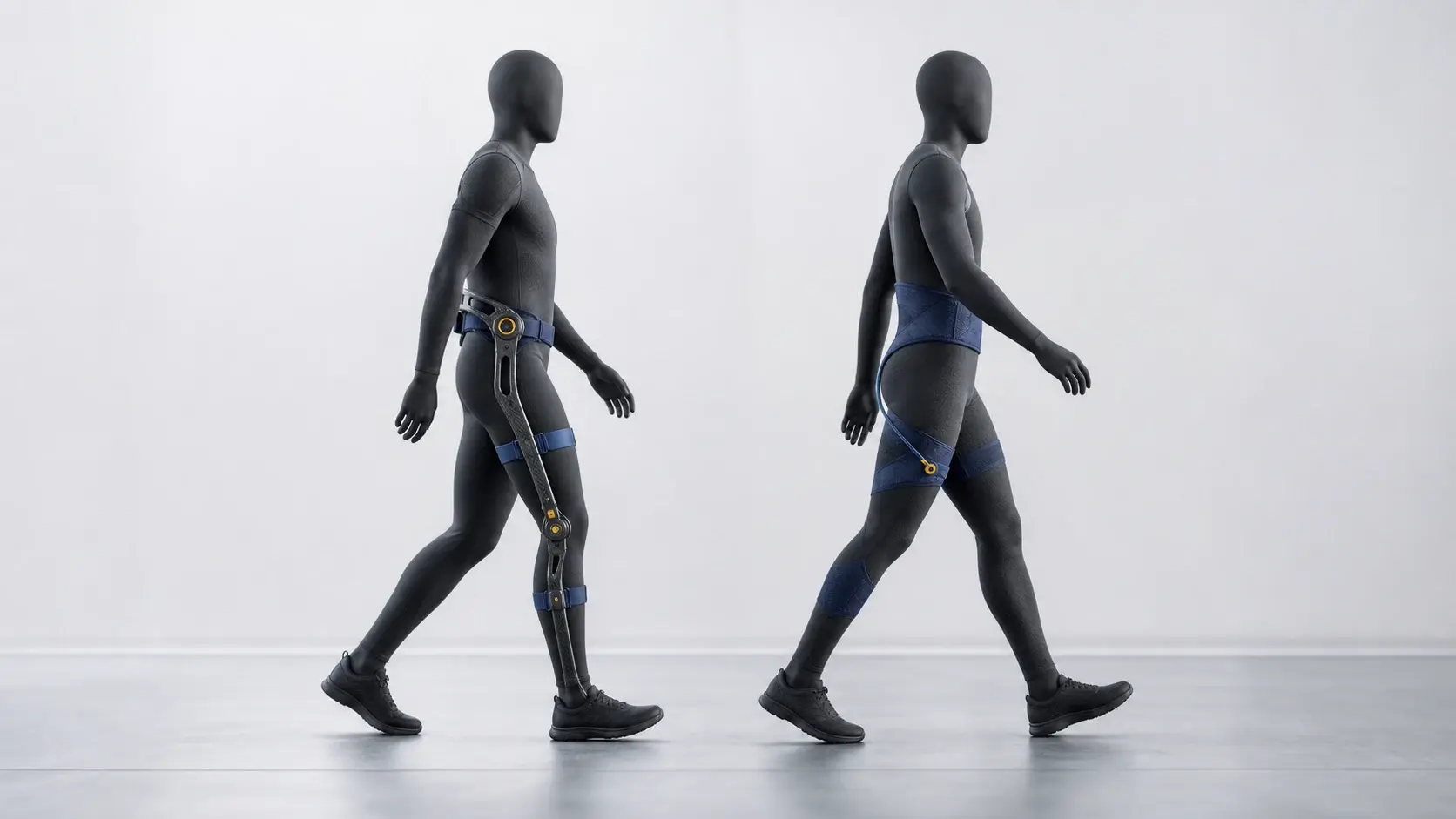
Rigid exoskeletons carry much of the reaction force through links, shells or braces. Soft exosuits rely mainly on tension through textiles, straps, cables or flexible actuators. Hybrid and semi-rigid designs combine defined stiff regions with compliant connections. The three labels describe an architecture spectrum, not quality grades.
A 2024 Biomimetics hip prototype had rigid waist and thigh segments but no hinge joining them, and the researchers called it semi-rigid. The more detailed exoskeleton-versus-exosuit guide examines load paths and anchor behavior; this page keeps structure as one field in the larger classification.
Four evidence examples, classified
This matrix classifies published prototypes by documented architecture. It does not compare outcomes, rank designs or generalize results beyond each study.
| Published example | Power | Body target | Structure |
|---|---|---|---|
| Nature 2022 portable ankle prototype | Powered motor | Ankle | Rigid carbon-fibre and aluminium frame with shoe and calf interfaces |
| Nature 2015 ankle prototype | Passive spring and clutch | Ankle | Rigid mechanical path |
| Scientific Reports 2023 suit-type prototype | Powered shape-memory-alloy actuator | Ankle | Soft garment and webbing-anchor path |
| Biomimetics 2024 hip prototype | Powered motors | Hip | Semi-rigid waist and thigh segments without a mechanical hip hinge |
What a type label does not establish
- Powered does not identify the structure, body target, function or intended use.
- Soft does not establish comfort, fit or delivered assistance; the anchors and complete interface still matter.
- Full body does not mean every covered joint is actuated or assisted.
- Hip, knee or ankle identifies a target, not the assistance direction, timing or task.
- A product name does not establish power source, architecture or intended use without exact-device documentation.
Sources
- ASTM F3323-24: Standard Terminology for Exoskeletons and Exosuits
- NIOSH: Industrial Exoskeletons
- Nature: portable rigid-frame ankle exoskeleton (2022)
- Nature: unpowered clutch-and-spring ankle exoskeleton (2015)
- Scientific Reports: garment-routed soft wearable robot (2023)
- Biomimetics: bilateral semi-rigid hip-exoskeleton study (2024)
Key facts
- One exoskeleton can belong to several types at the same time because each classification axis answers a different question.
- Powered versus passive identifies the assistance source, not whether the structure is rigid or soft.
- Body-region labels identify where a device acts, but not how it creates or transfers force.
- Rigid, soft and hybrid describe the load path more clearly than the product name alone.
- Intended use remains separate from architecture: similar-looking devices can belong to different markets.
Frequently asked questions
What are the main types of exoskeletons?
Classify exoskeletons on five separate axes: intended use, power source, body region, structure and function. A device usually has one label on every axis, so powered, soft and ankle assist can all describe the same system.
What is the difference between active and passive exoskeletons?
Active or powered systems use actuators such as motors, pneumatics or hydraulics. Passive or unpowered systems use body motion with springs, elastic elements, dampers, clutches or counterbalances.
What is the difference between an exoskeleton and an exosuit?
Exosuit usually describes a softer textile or cable load path, while exoskeleton often implies more rigid structure. Naming is inconsistent, so the actual anchors, links and force path are more informative than the product label.
What is a full-body exoskeleton?
A full-body exoskeleton spans several joints or body regions. The label does not mean every covered joint is actuated, so each active and passive degree of freedom still needs to be identified.