Exoskeleton vs Exosuit: What Actually Differs
Learn how rigid frames, textile anchors, cables and hybrid structures move force between a wearable device and the body.

Research standard: this guide draws on primary records, technical documentation and documented field experience. Volatile facts such as price, availability and firmware are reviewed on a dated schedule.
The short answer: compare structure, not the name
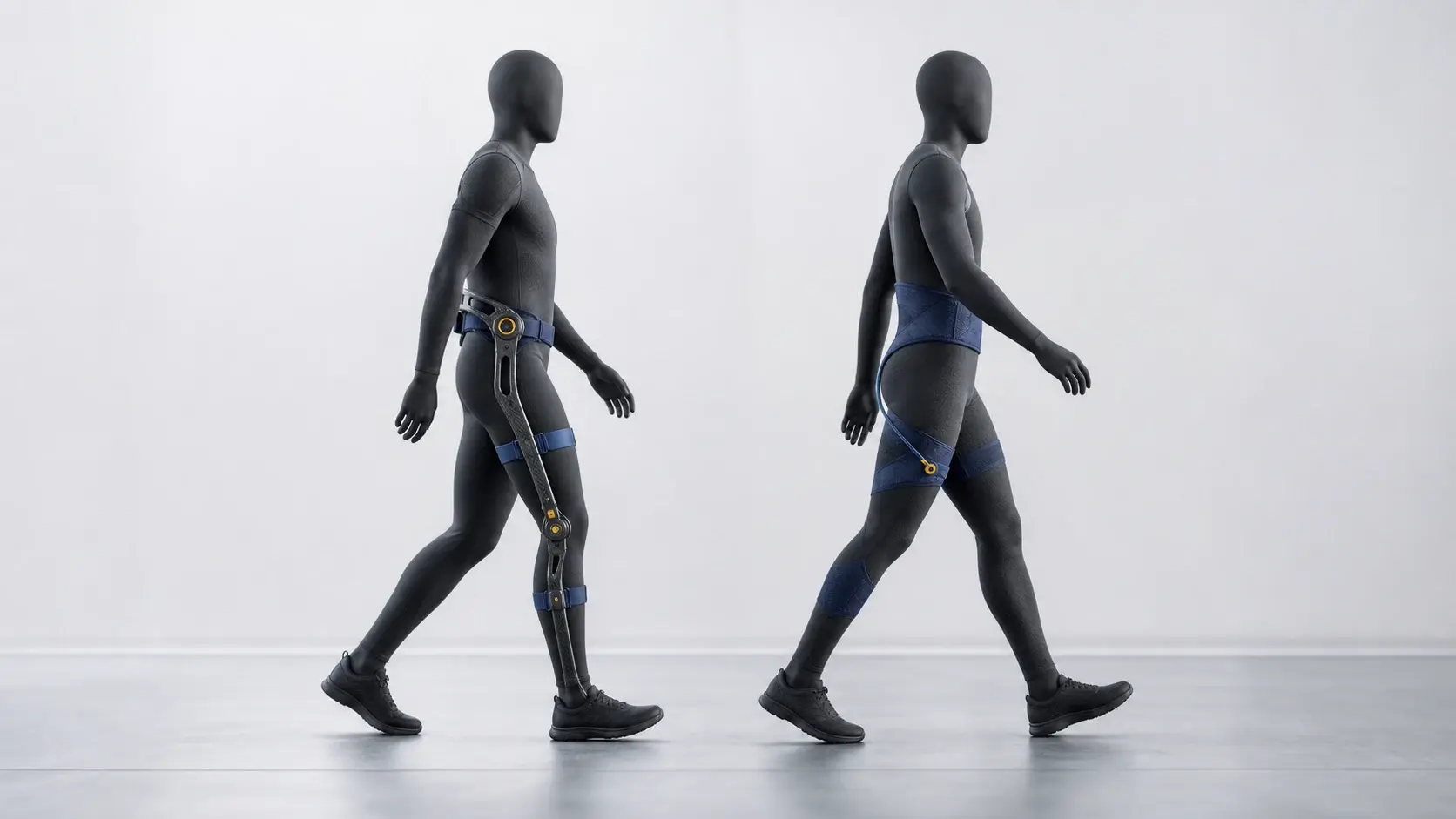
In common technical usage, exoskeleton points toward a wearable structure with rigid or semi-rigid members, while exosuit points toward a softer system built around garments, webbing, straps, cables or inflatable elements. The distinction describes how the device creates and transmits force. It does not, by itself, say whether the system has motors, whether it stores energy in springs, which joint it assists or which market it was designed for.
Naming remains inconsistent. Researchers may use soft exoskeleton, soft wearable robot and exosuit for closely related architectures. A company may choose exosuit because a device looks garment-like, while another may use exoskeleton as the broad category name. ASTM F3323-24 maintains a shared terminology standard for exoskeletons and exosuits, and Committee F48 covers both terms across multiple system types and application areas. That broad standards scope is a reason to record the design fields behind the label.
A useful comparison therefore begins with one question: where does the reaction force travel? If it travels mainly through rigid links aligned near the body, the design is closer to a conventional exoskeleton. If it travels mainly as tension through fabric, straps or cables anchored to body segments, it is closer to an exosuit. When both paths matter, semi-rigid or hybrid is the more informative description.
Exoskeleton versus exosuit comparison
The table compares architecture only. It does not rank comfort, output or suitability, because those depend on the complete device, fit, control strategy, task and evidence.
| Comparison field | Rigid or semi-rigid exoskeleton | Soft exosuit |
|---|---|---|
| Primary structure | Links, shells, braces or frames define much of the load path | Textiles, straps, cables, tendons or soft actuators define much of the load path |
| Force transfer | Compression, bending and tension can pass through structural members | Tension is commonly routed between separated body anchors |
| Joint relationship | May place a mechanical joint or end-effector near the assisted joint | May span a joint without a rigid hinge at that joint |
| Alignment question | How the device linkage follows the wearer’s joint motion | How anchors, fabric deformation and cable routing change the line of action |
| Compliance | Can include flexible links, padding and compliant transmissions | Can include stiffened panels, shells and localized rigid anchors |
| Power source | Powered or passive | Powered or passive |
| Best evidence field | Frame geometry, joint freedom, interface motion and measured delivered torque | Anchor position, garment stiffness, cable excursion, pressure and measured transmitted force |
This matrix avoids two common shortcuts. First, soft is not a synonym for passive: a textile system can use motors, pneumatic muscles or other powered actuators. Second, rigid is not a synonym for powered: a frame can redirect or store energy with springs and other passive elements. Architecture and actuation answer different questions and should occupy separate fields in a product or research record.
How a rigid exoskeleton carries force
A rigid exoskeleton creates an external mechanical path alongside part of the body. Links, braces or shells react against two or more contact regions, and the distance between those reactions creates a moment around a joint or supports a load path. A powered design may place an actuator near the joint or transmit power from a motor located elsewhere. A passive design may use springs, elastic elements or counterbalances while retaining a rigid frame.
A 2022 Nature study provides a clearly documented ankle example. Its portable system used carbon-fibre and aluminium frames, a motor and drum transmission, plus shoe and calf attachments. The frame carried the mechanical path, but the human-device connection still depended on the shoe and calf interface. The example is useful because it separates the structural member, the actuator, the transmission and the body attachments instead of treating the device as one undifferentiated object.
Rigid does not mean perfectly rigid everywhere. A 2024 hip-exoskeleton study used motors at the waist, flexible plastic orthotic attachments lined with fabric and carbon-fibre-reinforced thigh segments designed to flex around one axis. Those compliant choices allowed movement outside the primary assisted plane. The authors also noted that encoder angles at the exoskeleton could differ from biological hip angles because attachments moved relative to the body and soft tissue deformed under torque.
That limitation matters when reading specifications. A motor angle describes the device side of the interaction; it is not automatically the same as the wearer’s joint angle. Similarly, actuator torque is not automatically the torque delivered at a biological joint. Link geometry, interface movement, padding compression and alignment all sit between the commanded output and the effect at the wearer.
How a soft exosuit carries force
A soft exosuit typically creates a tensile path across or around the assisted joint. A cable, tendon, strap or contracting soft actuator pulls between anchors on different body segments. The body provides the compressive reaction that a separate rigid link might otherwise carry. This can reduce bulky external structure and allow motion in directions the suit is not actively loading, but it makes the garment and anchors part of the transmission.
Consider a cable that pulls from a waist anchor toward a thigh anchor. Cable tension alone does not describe the assistance reaching the wearer. The fabric can stretch, the anchor can rotate, the garment can slide over clothing and soft tissue can deform. Those changes alter cable excursion, delay force transfer and move the effective line of action. A soft system therefore needs mechanical reporting that goes beyond motor current or cable tension.
A 2023 Scientific Reports prototype shows this distributed path directly. Its shape-memory-alloy wire routed force through garment anchors at the shoulder, waist, thigh and ankle. During development, the researchers documented garment deformation and slippage, then changed fabrics and support geometry. The study is not a category benchmark; it is evidence that textile selection, anchor placement and force routing are functional engineering choices.
A 2025 Scientific Reports study investigated the same general problem from the anchor itself. Its soft wearable robot compared anchoring structures under controlled actuator input and measured transmitted force and pressure distribution. The study’s proposed structure combined greater stiffness in the loading direction with compliance around the limb. That anisotropic design illustrates why soft and rigid are not single material properties: an exosuit can be compliant in one direction and deliberately stiff in another.
Soft also does not guarantee an invisible interface. Force must still close through the body, so anchors need enough grip or geometric purchase to resist motion. Wider or distributed contact can spread a load, while concentrated anchors can define a clearer path; neither choice establishes the result without measurements. Useful exosuit evidence reports where the anchors sit, how the textile deforms and what was measured at the interface.
Hybrid and semi-rigid systems fill the middle
Many wearable robots deliberately combine rigid and soft elements. They may use a rigid waist shell with textile thigh cuffs, a cable transmission connected to a carbon-fibre brace, or stiff panels joined by compliant straps. Calling every such system either rigid or soft can hide the feature that most affects force transfer.
A 2024 Biomimetics prototype used rigid waist and thigh segments but no hinge joining them, and the researchers described it as semi-rigid. The structure sought a more defined anchor than a fully textile suit while allowing more freedom than a conventional hinged frame. Its study results do not prove that a semi-rigid design is universally better; they demonstrate that architecture can be intentionally positioned between the endpoints.
The most useful label for a hybrid states both the stiff and compliant parts. For example: rigid waist and thigh anchors with no mechanical hip hinge; textile garment with localized stiffened anchor panels; or rigid ankle frame with a cable transmission. That description lets readers reconstruct the load path without relying on a category word that different teams may use differently.
Powered versus passive is a separate axis
NIOSH’s architecture-neutral distinction is useful here: active systems receive power through actuators such as electric, pneumatic or hydraulic mechanisms, while passive systems are driven by the wearer’s movement through elements such as springs and counterbalances. An exosuit can therefore be active or passive, just as a rigid exoskeleton can be active or passive.
| Structure | Powered example pattern | Passive example pattern |
|---|---|---|
| Rigid or semi-rigid | Motor applies torque through links, braces or a defined end-effector | Spring or counterbalance redirects energy through a frame |
| Soft or textile | Remote motor, pneumatic element or artificial muscle tensions a garment path | Elastic bands store and return energy between textile anchors |
| Hybrid | Powered transmission connects rigid anchors through compliant elements | Rigid anchor regions guide elastic or spring-based force without a motor |
The same separation applies to control. A powered device may synchronize output from joint angles, inertial sensors, foot contact or another measured signal. A passive device responds through geometry, stiffness and pretension rather than a software controller. None of those control details can be recovered reliably from the words exoskeleton or exosuit alone.
The label does not determine intended use
Architecture also does not establish the device’s intended use. Consumer, occupational, medical and research systems can each use rigid, soft or hybrid structures. A garment-like appearance does not make a device a general consumer product, and a visible frame does not establish a regulated medical purpose. Intended use comes from the exact device documentation and evidence, not from shape or naming.
This is why broad search results can be misleading. Two devices may both be called exosuits while targeting different joints, tasks and users. Two exoskeletons may share a rigid appearance while using different power sources and interaction principles. Before making any product comparison, normalize the intended use, assisted body region, actuation, structure and evidence class.
How to read a study or specification
Start by drawing the load path in words. Identify the two or more places where the device reacts against the body, the element that connects them and the direction of the applied force. Then separate actuator output from interface output. A motor rating, cable tension or spring stiffness is an input to a coupled human-device system, not a complete description of what reaches the wearer.
- Name the assisted joint or body region and the direction of assistance.
- Classify the primary load path as rigid, soft or hybrid, then list the actual links, textiles, cables and anchors.
- Record whether actuation is powered or passive without inferring it from the architecture label.
- Locate the actuator and note how power or tension reaches the body interface.
- Distinguish commanded motor output from measured cable force, interface force or joint torque.
- Check whether the study reports attachment movement, fabric stretch, pressure, slippage or alignment.
- Preserve the exact prototype, participants, task, speed and comparison condition for any numerical result.
- Treat intended use and market class as separate fields supported by exact-device documentation.
This method also prevents a false universal trade-off. It is tempting to say that rigid systems provide more force while soft systems provide more comfort, but those conclusions depend on specific designs and tests. A rigid system can add compliance and distributed padding; a soft system can add stiff anchors and concentrated loads. The better question is whether the tested structure delivered the intended force while preserving the movements relevant to that protocol.
When the terminology matters
Use exoskeleton when a rigid or semi-rigid external structure is central to the description. Use exosuit when textile or compliant force transmission is central. Use soft wearable robot when the research source uses that term and the exact mechanism is clear. For mixed systems, add hybrid or semi-rigid and describe the components. Preserving the source’s term while adding an architecture description is usually more accurate than silently forcing every device into one naming convention.
For readers comparing products, the terminology is a filter rather than a verdict. It helps reveal likely questions about alignment, garment deformation, anchors and movement freedom. It cannot establish real-world performance, fit or suitability on its own. Those decisions require exact-model evidence and a comparison within the same intended-use class.
Sources
- ASTM F3323-24: Standard Terminology for Exoskeletons and Exosuits
- ASTM Committee F48 on Exoskeletons and Exosuits
- NIOSH: Industrial Exoskeletons
- Scientific Reports: anisotropic anchoring for a soft wearable robot (2025)
- Scientific Reports: garment-routed soft wearable robot (2023)
- Nature: portable rigid-frame ankle exoskeleton (2022)
- Frontiers: comparison of two hip-exoskeleton controllers (2024)
- Biomimetics: bilateral semi-rigid hip-exoskeleton study (2024)
Continue your research
Key facts
- Exoskeleton and exosuit describe architecture more reliably than power source or intended use.
- Rigid links define a mechanical load path, but their body attachments can still move and deform.
- Soft exosuits transmit force through tension and need anchors that resist slipping and fabric stretch.
- Powered versus passive is a separate comparison: both rigid and soft systems can use either approach.
- Semi-rigid and hybrid devices make the category a spectrum rather than a clean two-box split.
Frequently asked questions
What is the main difference between an exoskeleton and an exosuit?
The most useful difference is the primary load path. Exoskeleton usually suggests rigid or semi-rigid links, while exosuit suggests textiles, straps, cables or other compliant elements. Real naming overlaps, so check the actual structure.
Is an exosuit always soft?
It is usually mostly soft or garment-based, but it may include rigid or stiffened anchors, actuator housings and other structural parts. Describe those components rather than assuming the entire system has one stiffness.
Are exosuits passive and exoskeletons powered?
No. Powered versus passive is independent of rigid versus soft. Motors or pneumatic actuators can power either architecture, while springs or elastic elements can create passive rigid, soft or hybrid systems.
Is an exosuit better than an exoskeleton?
The label cannot answer that. Compare the assisted movement, load path, anchor behavior, delivered force, freedom of movement, intended use and evidence from the exact system under relevant test conditions.