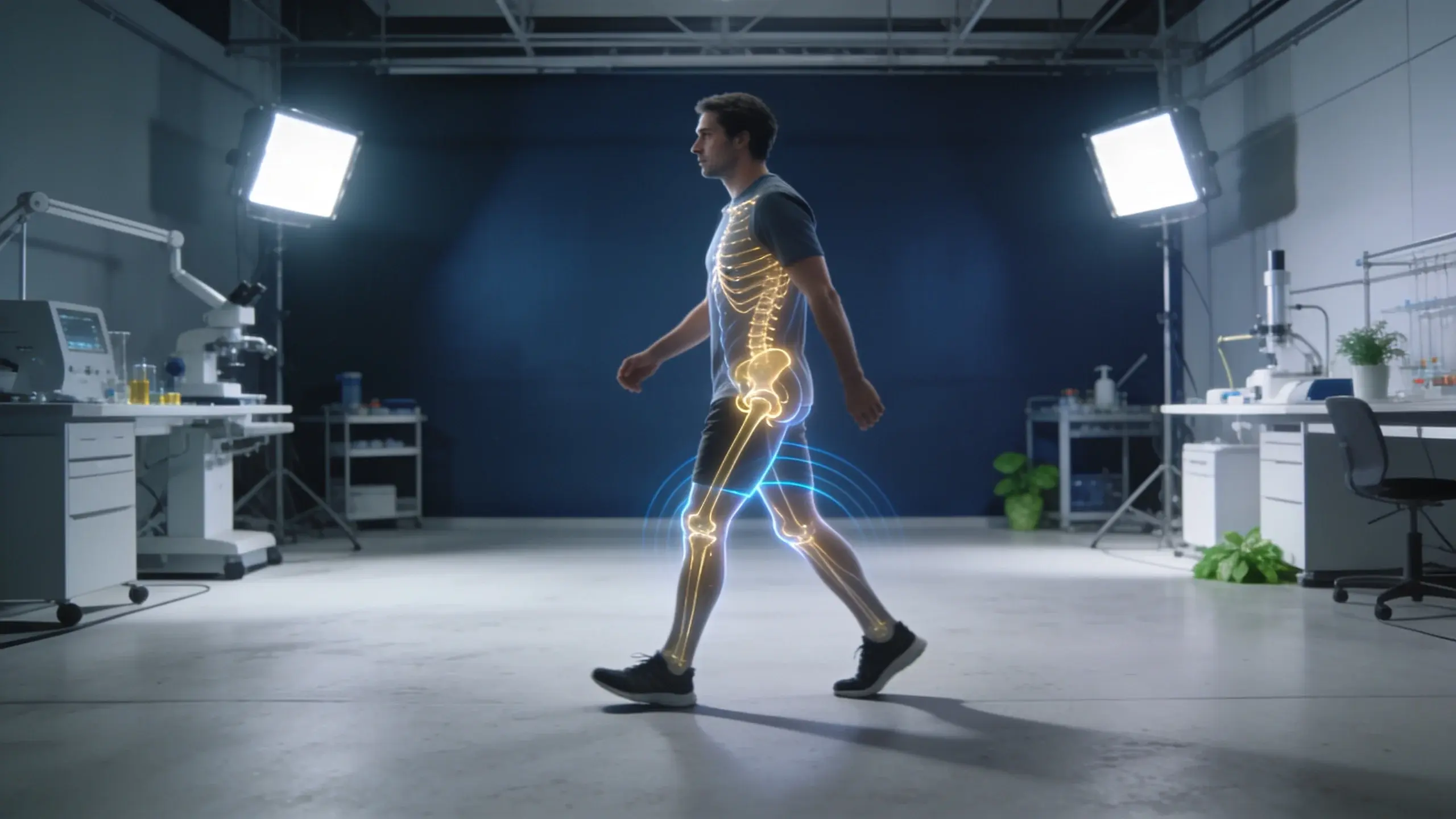
Hip vs Knee Exoskeletons: A Mechanical Comparison
A research-led comparison of hip and knee assistance, from force paths and gait timing to device interfaces and study limits.

Research standard: this guide draws on primary records, technical documentation and documented field experience. Volatile facts such as price, availability and firmware are reviewed on a dated schedule.
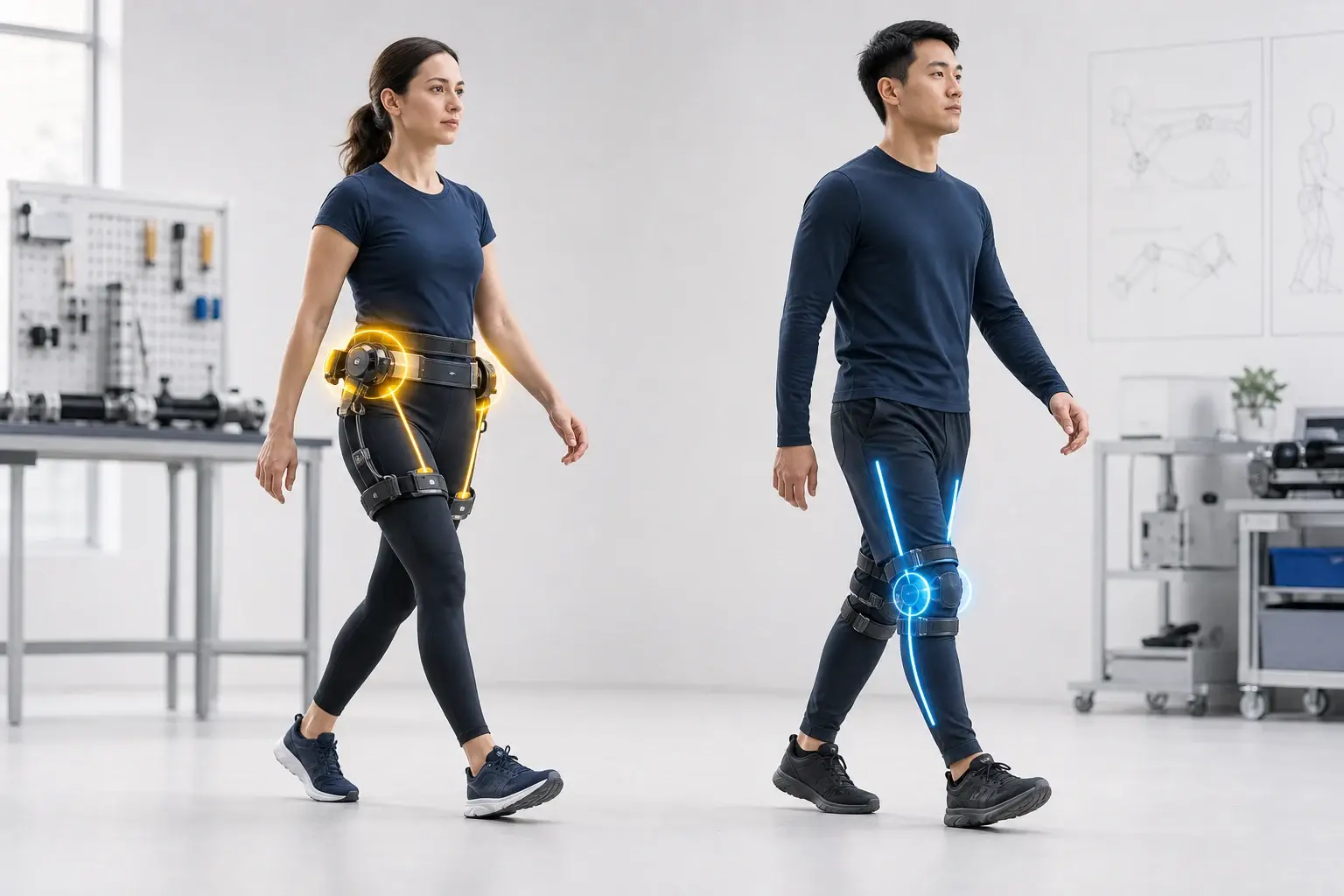
Hip versus knee assistance at a glance
The useful difference is mechanical, not cosmetic. A hip-assist system creates, stores or redirects a moment around the hip through contacts on the pelvis or waist and the thigh. A knee-assist system does the same around the knee through contacts above and below it, usually on the thigh and shank. Those different endpoints change which body segments carry the reaction forces and which movement can be assisted.
That distinction does not produce an automatic winner. Hip flexion, hip extension, knee flexion and knee extension occur at different times and contribute differently across level walking, slopes, stairs, running, squatting and transitions. A design can also span both joints. The correct comparison therefore begins with the intended mechanical action, then follows its load path, timing, interface and evidence.
| Comparison field | Hip assistance | Knee assistance |
|---|---|---|
| Primary body segments | Pelvis or waist and thigh | Thigh and shank |
| Common assisted directions | Hip flexion, extension or both | Knee flexion, extension, resistance or energy return |
| Typical rigid geometry question | How links and attachments follow the thigh relative to the pelvis | How a device joint follows a biological joint with a changing rotation center |
| Typical soft-system question | How waist and thigh anchors transmit cable force | How thigh and calf anchors maintain the intended line of action |
| Evidence needed | Direction, profile, interface, task and baseline | Direction, profile, alignment or anchor behavior, task and baseline |
These are comparison fields, not universal design rules. A hinge-free hip system can use rigid anchor pieces, and a knee system can move its actuator closer to the torso through cable transmission. Product names also overlap: researchers may use exoskeleton, exosuit, wearable robot or orthosis for systems with different structures. Record the hardware behind the term before comparing claims.
How hip assistance creates a moment
A hip system normally closes its force path between a proximal interface around the waist or pelvis and a distal interface on the thigh. If a cable pulls those anchors together, or a motor rotates a linked thigh segment relative to a pelvis frame, the spacing between the forces creates a moment around the hip. The direction and timing determine whether the system primarily supports flexion, extension or both.
The architecture does not need a rigid hinge at the anatomical joint. A 2024 semi-rigid research exoskeleton used rigid waist and thigh segments that were not connected by hinges. Off-board actuation applied hip-extension force, while springs contributed flexion assistance. The paper describes a hybrid load path: the anchors were stiffer than an all-textile suit, but their lack of a mechanical hip hinge allowed additional freedom of movement.
A soft hip exosuit makes the body interface even more visible. In a 2022 Scientific Reports study, a bilateral suit used an off-board actuator while eight male participants walked on a treadmill at 1.25 metres per second. The optimized peak force ranged from 67 to 127 newtons, and no two participants converged on the same full profile. That experiment shows why joint location alone cannot specify useful magnitude or timing.
Control strategy can change the interpretation without changing the assisted joint. A 2024 study compared two controllers on the same hip-exoskeleton platform with 23 participants walking at 4 kilometres per hour. One controller derived assistance from relative foot loading; the other estimated gait percentage from hip angle and applied shorter preset bursts. The different profiles and baselines produced different measured results, so “hip assisted” is not a complete experimental condition.
How knee assistance creates a moment
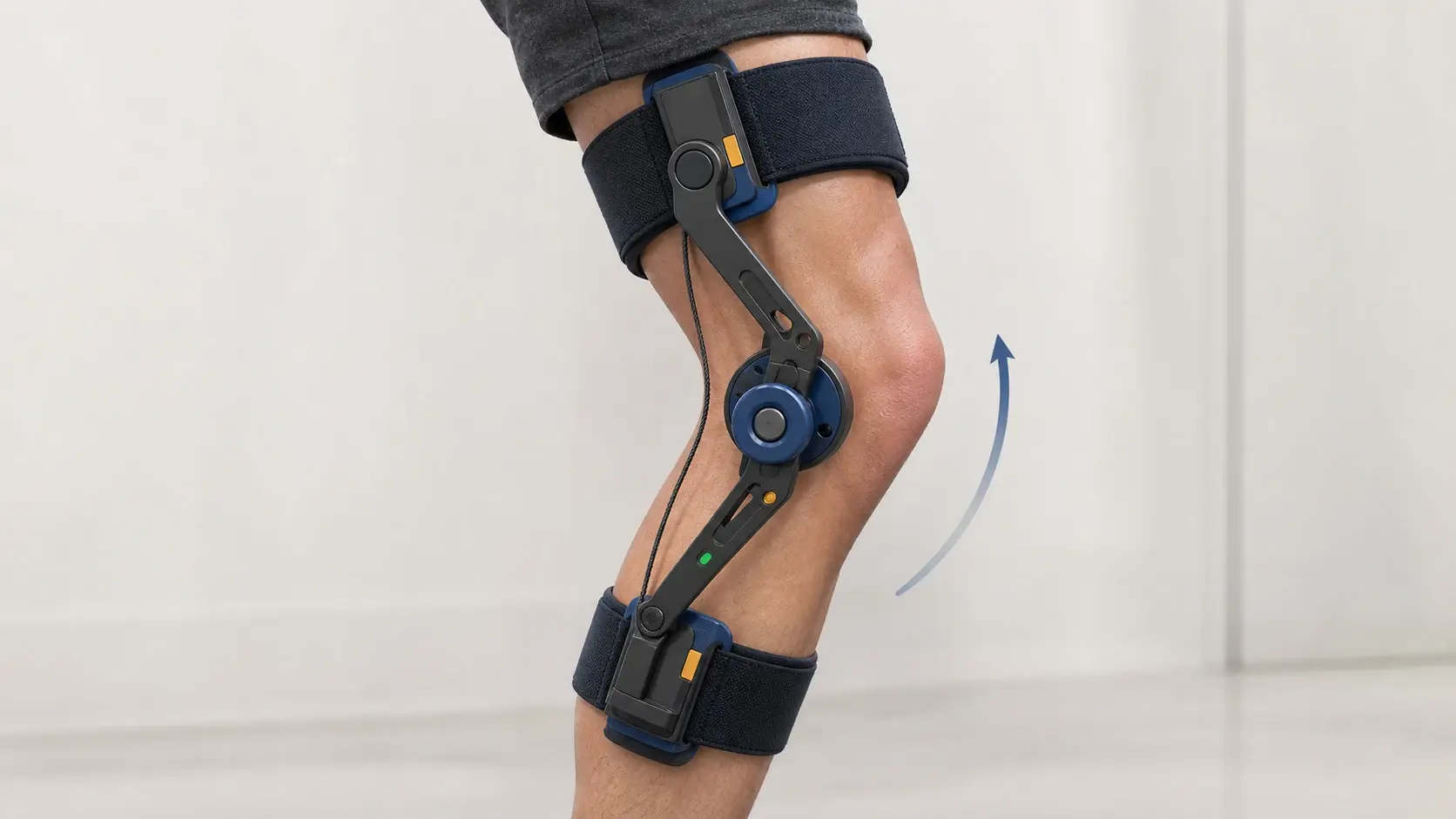
A knee system generally reacts between thigh and shank interfaces. A rigid architecture may place a device joint beside the knee and rotate the shank link relative to the thigh link. A cable-driven frame can locate a motor elsewhere and transmit force to that joint. A soft exosuit can cross the knee with a cable or tendon and pull directly between wearable anchors without any rigid hinge spanning the joint.
The biological knee does not behave like a single fixed-axis door hinge. Its relative femur–tibia motion includes rotation and translation, so the apparent center of rotation changes with angle. A 2022 Frontiers prototype used rolling gears to approximate that changing path. The authors separated simulation, benchtop measurement and torque-tracking tests with three treadmill participants, which prevents one evidence layer from being mistaken for another.
Soft architecture avoids matching a rigid hinge to that moving center, but it creates a different measurement problem. A hinge-free knee exosuit described in 2020 routed a Bowden cable across the front of the knee between semi-rigid thigh and calf wraps. Its authors stated that the body anchors carried the shear load rather than a rigid frame. Anchor position, fabric movement and cable moment arm therefore became central to interpreting applied knee moment.
That knee-exosuit study tested six healthy participants walking uphill and downhill on a treadmill at a ten-degree slope. The actuation stayed off body, while the worn components totalled 1.14 kilograms in a unilateral setup and 1.72 kilograms bilaterally. Those details define the experiment. They do not describe a self-contained consumer device, level overground walking or every knee-assistance architecture.
Joint target and gait phase must stay together
Hip and knee angles repeat during walking, but their mechanical roles are not interchangeable. Hip extension and flexion move the thigh relative to the pelvis across stance and swing. The knee flexes and extends in both phases, shortening the leg during swing and changing how the limb supports and redirects motion during stance. A joint label without the assisted direction and phase discards most of the mechanism.
| What to record | Why it matters | Incomplete shorthand |
|---|---|---|
| Assisted joint and direction | Separates hip flexion from hip extension and knee flexion from knee extension | Hip assist or knee assist |
| Onset, peak and offset | Defines where assistance sits within the movement cycle | Maximum torque only |
| Activity and condition | Level walking, slopes, running and squatting create different profiles | Walking tested |
| Laterality | Unilateral and bilateral systems create different configurations | Leg assistance |
| Baseline | No device, worn-unpowered and alternative controllers answer different questions | Compared with control |
Timing also limits cross-paper comparisons. The 2022 hip-flexion study optimized peak force, peak timing and offset timing for each participant. The 2024 hip-controller study compared a longer emergent profile with shorter predefined bursts. A knee paper may instead shape assistance around stance extension or a slope-specific power region. These studies can inform a reporting framework, but their numerical outcomes cannot be placed in one winner column.
Rigid, soft and multi-joint designs cut across the labels
Hip versus knee is only one axis of classification. Either joint can be assisted by powered motors, passive springs or a combination. Either can use rigid links, textile anchors or a hybrid structure. Power source describes how energy enters the system; rigid versus soft describes the main force path; hip versus knee describes where the external moment acts. Keeping those axes separate prevents category errors.
Multi-joint systems make the boundary even clearer. A 2022 Sensors study described a 550-gram unpowered hip–knee prototype whose biarticular exo-tendon connected a waist structure to shank frames. Across different gait phases, the spring path produced hip-extension and knee-extension moments. Eight healthy male participants tested the system while walking at 1.5 metres per second and running at 2.5 metres per second.
That prototype was not half hip device and half knee device in a way that can be scored independently. One elastic path coupled the joints, and its moment arms changed with hip and knee angle. Multi-articular assistance should therefore be documented as its own architecture: list every spanned joint, the direction and phase of each moment, the shared transmission and the exact comparison condition.
Even single-joint assistance can change motion elsewhere. The 2022 hip-flexion study measured changes at the hip, knee and ankle as force magnitude increased. That is not evidence that a hip device secretly becomes a knee exoskeleton. It is a reminder that the wearer is a connected mechanical system. The assisted joint identifies where the device applies its primary external moment, not the only place where movement can change.
How to compare hip and knee research fairly
A fair comparison normalizes the study description before reading the outcome. Start with the exact prototype and whether it is tethered, portable, powered or passive. Record the body segments touched by the device, any rigid joint or compliant transmission, the assisted direction, the controller or spring behavior and every component included in the worn configuration.
| Evidence field | Question to answer |
|---|---|
| Prototype boundary | Which exact hardware, side count, energy source and off-body equipment were used? |
| Force path | Where do reaction forces enter the waist, thigh or shank, and which joint or joints are spanned? |
| Control or passive behavior | What triggers the moment, and how are magnitude and timing selected? |
| Experiment | Who participated, what task and speed or slope were used, and how long was each condition? |
| Measurement | Was output commanded, measured at the device, estimated at the body or inferred from another signal? |
| Baseline | Was the comparison no device, worn but unpowered, a different controller or another architecture? |
ASTM F3323-24 provides a common terminology scope for exoskeletons and exosuits across research, design, deployment and use. The standard helps establish a shared lexicon; it does not make unlike experiments directly comparable. For a hip-versus-knee decision, the joint label is a first filter. The fields above carry the evidence needed for the actual comparison.
What this comparison cannot decide
The published studies here do not form a head-to-head trial of one hip system against one knee system under the same protocol. They use different devices, participants, tasks, speeds, slopes, controllers and baselines. Comparing their percentages or peak outputs as if they came from one experiment would create a false ranking. The strongest answer supported by the evidence is architectural: the joint target changes the load path and evaluation questions.
The comparison also does not establish suitability for a person, task or current product. Those questions require exact-model evidence from the relevant intended-use class. Use this guide to identify which joint and mechanism a system targets, then move to the dedicated hip or knee guide for deeper study interpretation and to model-specific records for any product claim.
A practical comparison checklist
- Name every assisted joint and the direction of each external moment.
- Trace the force path through waist, thigh and shank interfaces.
- Classify power source and rigid, soft or hybrid architecture separately.
- Record onset, peak, duration and offset rather than peak output alone.
- Separate a rigid-joint alignment question from a soft-anchor deformation question.
- Preserve participant count, activity, speed or slope, familiarization and baseline.
- Keep simulation, benchtop measurements and human-use results in distinct evidence fields.
- Do not convert unlike prototype results into a product verdict or universal joint ranking.
Sources
- ASTM F3323-24: Standard Terminology for Exoskeletons and Exosuits
- Scientific Reports: optimized hip-flexion assistance from a soft exosuit (2022)
- Frontiers: comparison of two hip-exoskeleton controllers (2024)
- Biomimetics: bilateral semi-rigid hip-exoskeleton study (2024)
- IEEE Transactions on Medical Robotics and Bionics: hinge-free knee-extension exosuit (2020)
- Frontiers in Human Neuroscience: self-aligning cable-driven knee exoskeleton (2022)
- Sensors: unpowered hip–knee energy-modulation study (2022)
Continue your research
Key facts
- Hip and knee assistance describe where an external moment acts, not one fixed product design.
- Hip systems commonly react between a waist or pelvis interface and the thigh; knee systems usually react between thigh and shank interfaces.
- A powered or passive design can target either joint, and soft or rigid structures can appear in both groups.
- Knee mechanisms face a changing center of rotation, while hip systems still have to manage attachment motion and soft-tissue deformation.
- Results from different prototypes are not a head-to-head test unless the hardware, task, participants and baseline are comparable.
Frequently asked questions
What is the main difference between a hip and knee exoskeleton?
The primary external moment acts at a different joint. Hip systems usually react between the pelvis or waist and thigh; knee systems usually react between thigh and shank. That changes the force path, interfaces, timing and evidence needed.
Is a hip exoskeleton better than a knee exoskeleton?
Not as a category-wide rule. The labels identify joint targets, not overall quality. Compare the exact assisted direction, architecture, movement, controller or passive behavior, test protocol and intended-use class.
Can one exoskeleton assist both the hip and knee?
Yes. Multi-joint systems can use separate actuators or one coupled elastic or cable path across both joints. Each joint moment, movement phase and shared transmission still needs to be documented separately.
Do hip and knee exoskeleton studies use comparable torque numbers?
Only when the measurement boundary and protocol match. Peak, continuous, commanded, measured and estimated torque are different fields, and results from different joints, tasks, speeds, hardware and baselines should not be ranked directly.