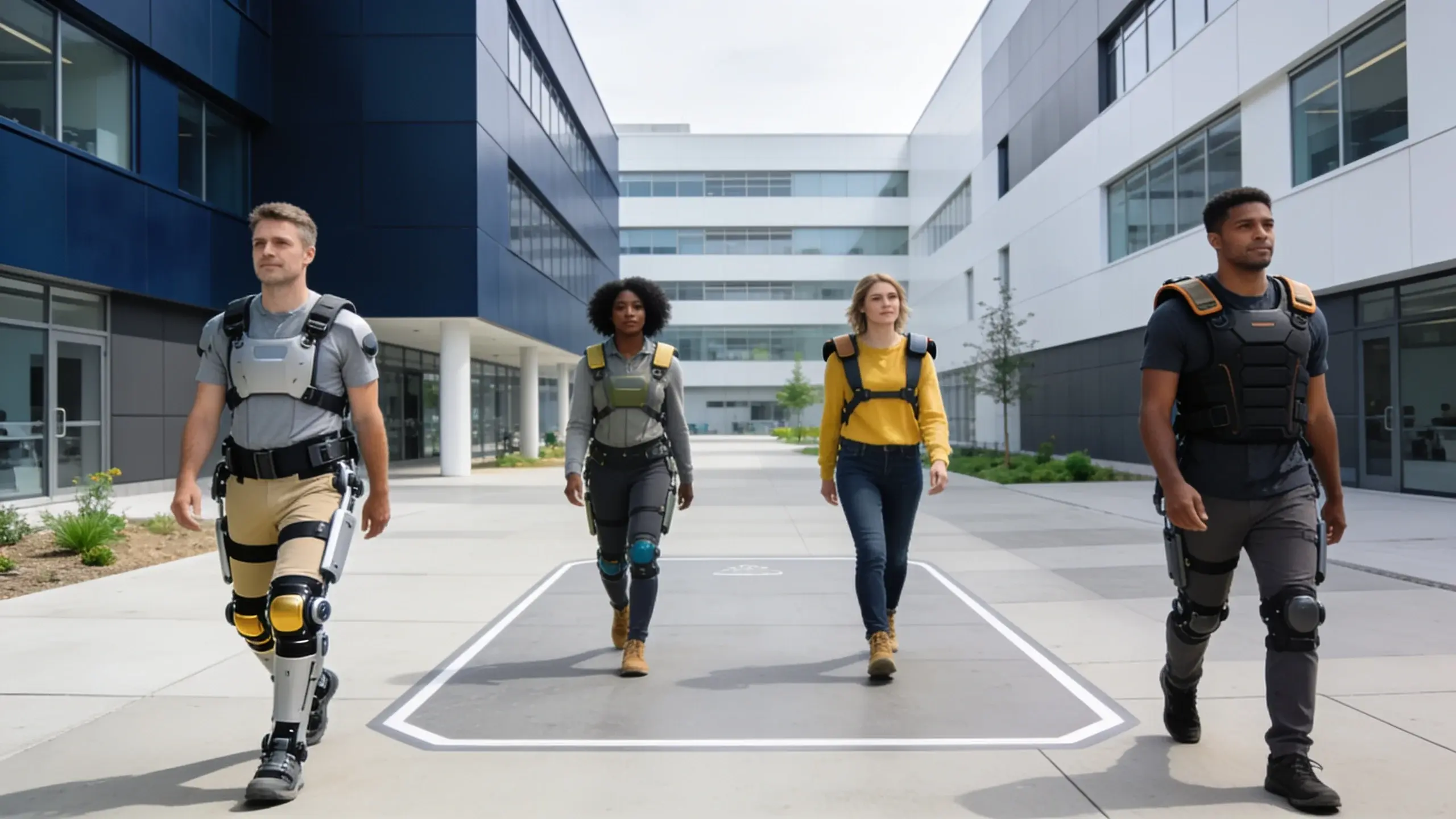
Hip Exoskeletons: How Hip Assistance Systems Work
A research-led guide to hip flexion and extension assistance, wearable interfaces, control timing, architecture and study limits.

Research standard: this guide draws on primary records, technical documentation and documented field experience. Volatile facts such as price, availability and firmware are reviewed on a dated schedule.
What counts as a hip exoskeleton
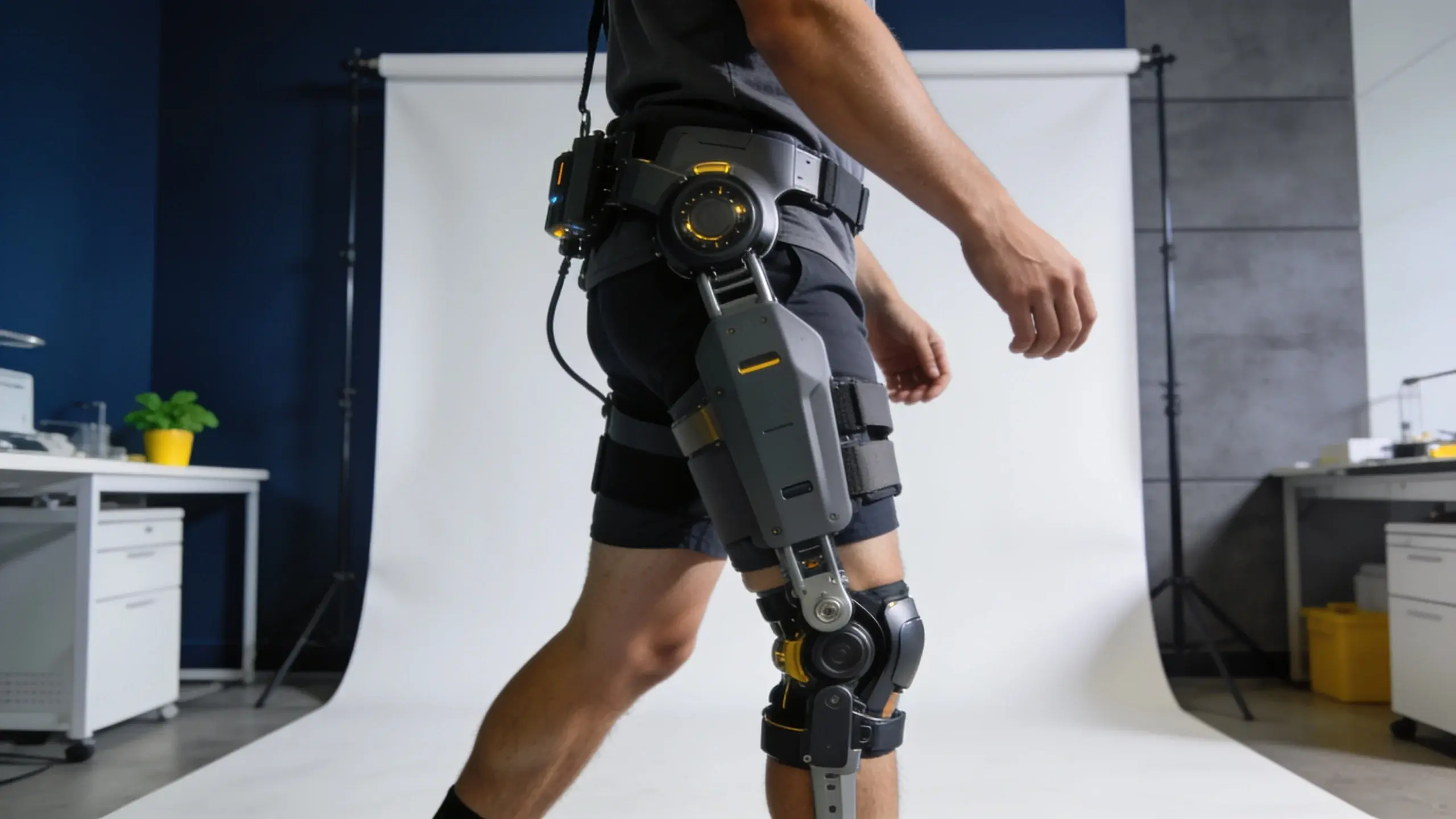
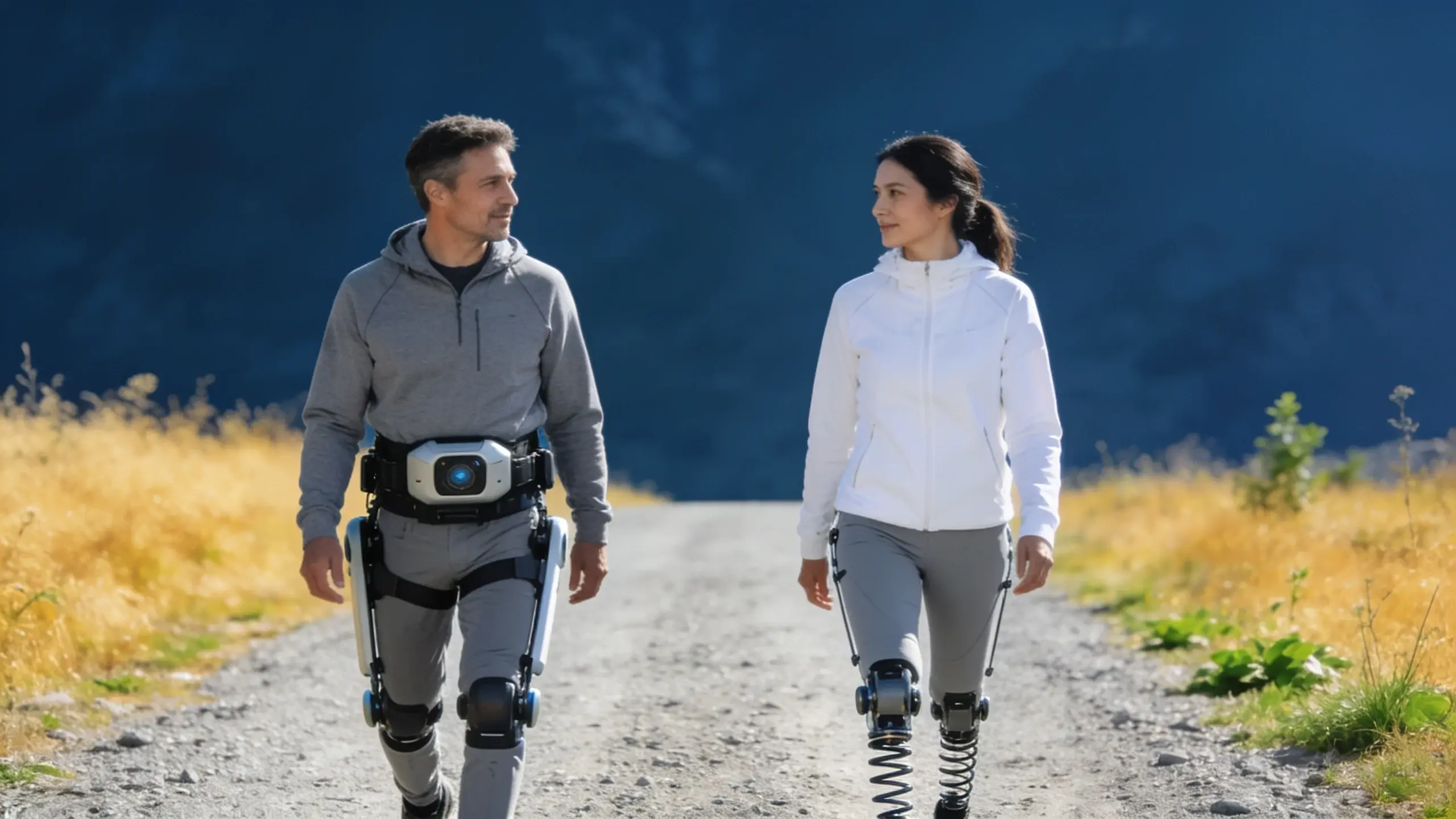
Hip exoskeleton is a location-based description. The device creates, stores or redirects a moment around the hip, then transfers that effect through a wearable interface such as a waist belt, pelvis frame, thigh cuffs or textile anchors. It may act on one side or both. The structure can be visibly rigid, mostly textile or a hybrid of rigid anchors and flexible force transmission.
That broad definition explains why hip exoskeleton, hip-assist exoskeleton and hip exosuit are sometimes used for overlapping systems. Exosuit usually signals a softer textile architecture, but naming is inconsistent across research and product pages. The reliable comparison fields are the assisted direction, power source, force path, body interface and intended use—not the marketing label.
ASTM Committee F48 also treats exoskeletons and exosuits as a broad standards domain spanning active and passive systems and multiple application areas. Its human-factors subcommittee maintains separate work on functional parameters, quantitative measures, reporting structure and fit accommodation. That division is a useful editorial lesson: a single output number cannot replace a description of the complete human-device system.
Original ExoRank visual
Six layers of a hip-assistance system
Read a hip-assistance system as six connected layers. Powered hip exoskeleton is only a starting label: actuation, force transmission, body interfaces, timing and test evidence still need separate documentation.
1. Assistance target
Hip flexion, extension, both directions or passive energy return
Which direction and movement phase are being assisted?
2. Assistance source
Powered actuator or passive elastic element
Where does the system obtain or store the force?
3. Transmission
Rigid links, flexible segments, cables, tendons or springs
How does output travel toward the body?
4. Body interface
Waist or pelvis reaction paired with thigh attachments
Where does the force react against the wearer?
5. Timing or response
Sensor-led control profile or passive geometry and stiffness
What synchronizes assistance with movement?
6. Evidence boundary
Exact device, protocol, measurement and comparison condition
What was tested, measured and used as the baseline?
Hip flexion and extension are different targets
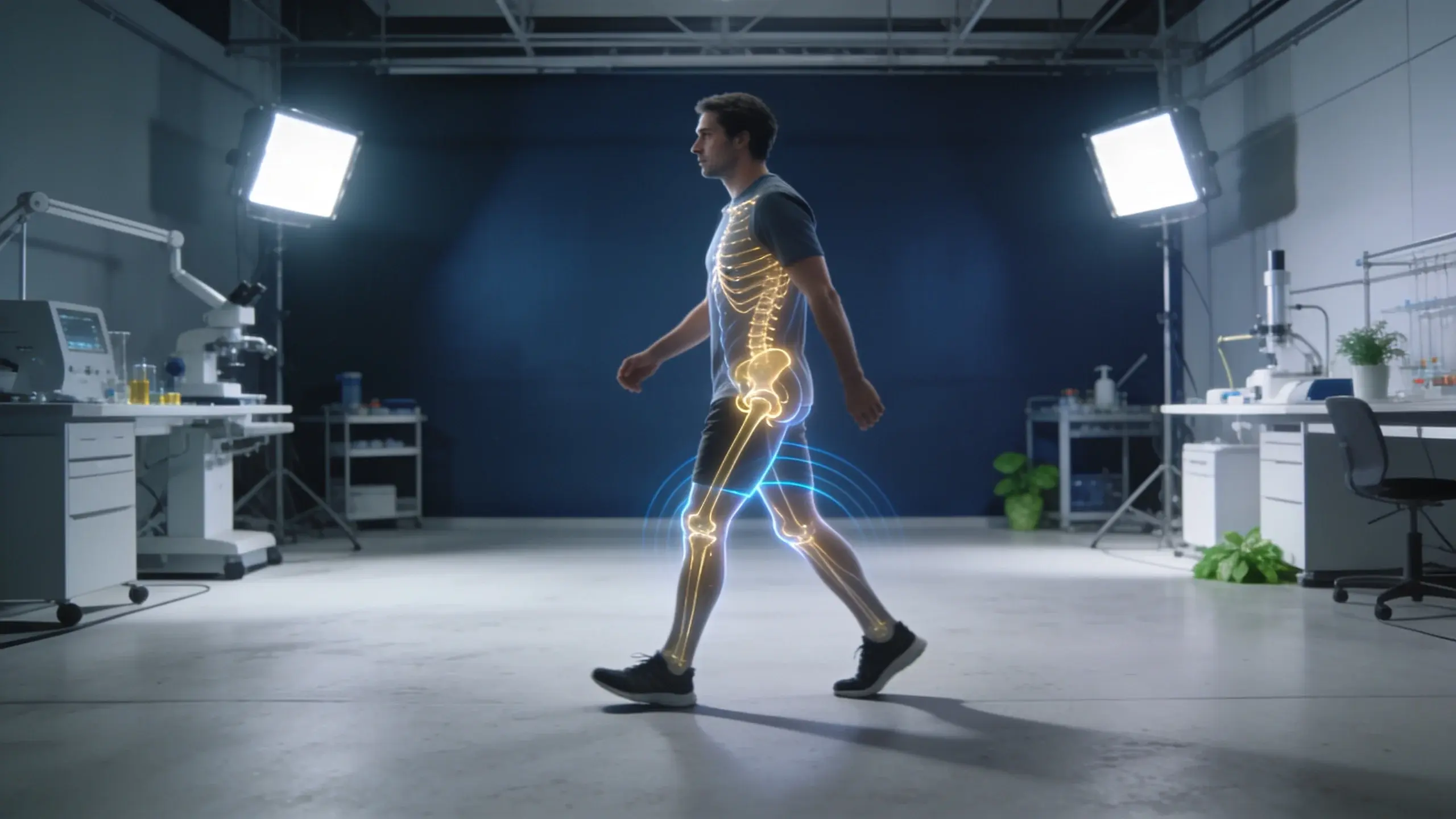
The hip moves in several planes, but walking-assistance research often focuses on flexion and extension in the direction of travel. Flexion brings the thigh forward toward the torso; extension moves it backward relative to the pelvis. A bilateral system can apply different assistance to the left and right sides as their stance and swing phases alternate.
| Assistance target | When it commonly matters in a gait cycle | What the label does not prove |
|---|---|---|
| Hip flexion | Advancing the thigh during swing | That every step, speed or transition is recognized correctly |
| Hip extension | Supporting backward hip moment during stance | That more torque always produces a better whole-body result |
| Flexion and extension | Applying direction-specific assistance across alternating phases | That the same profile suits every wearer or movement |
| Passive energy return | Storing energy in one phase and releasing it in another | That the timing and spring behavior match all walking or running speeds |
A device that assists flexion is not simply a weaker or stronger version of one that assists extension. It targets a different biological moment and may use a different anchor arrangement. Even when a system assists both directions, the magnitude, onset, peak and offset can be controlled independently. Product comparisons should therefore record direction and timing rather than collapsing everything into a single assistance figure.
Four common architecture patterns
| Architecture | Typical force path | Research question it raises |
|---|---|---|
| Rigid powered frame | Actuator and mechanical links aligned near the pelvis and thigh | How joint alignment, link geometry and worn mass affect force transfer |
| Soft powered exosuit | Cables or tendons pull between textile anchors | How fabric deformation, anchor position and cable routing change delivered force |
| Semi-rigid hybrid | Rigid waist or thigh anchors connected through compliant elements | Whether added freedom can preserve control accuracy and stable anchoring |
| Passive spring system | Elastic elements store and return energy without a powered actuator | Which movement and speed match the selected stiffness and pretension |
Rigid does not automatically mean precise, and soft does not automatically mean comfortable. A rigid link can define a clearer mechanical path while still moving relative to the body if the interface is poorly matched. A textile anchor can reduce bulky structure but deform under load. Semi-rigid designs deliberately combine fixed and compliant elements, while passive systems trade powered control for a mechanical response set by geometry and elasticity.
The location of mass matters too. Hardware carried near the waist is mechanically different from the same mass placed farther down the leg, but total mass still does not describe pressure distribution, movement of the frame or the force needed to keep anchors in place. This is why a useful specification record separates device mass, where it is carried and whether the quoted configuration includes batteries, cuffs and soft goods.
How assistance reaches the wearer
The actuator does not apply torque directly to a mathematical hip joint. It pushes or pulls through contact points on the body. A waist structure reacts against the pelvis or torso while thigh attachments create the opposing force. The spacing between those forces creates a moment around the hip. As straps stretch, soft tissue moves and the frame shifts, the commanded actuator output and the assistance reaching the wearer can diverge.
A 2025 portable hip-exoskeleton study evaluated actuation, wearable interface and controller together. Within that prototype, changing the waist interface affected measured contact forces, frontal-plane wobble and metabolic results. The important general lesson is not to transfer the paper's percentages to commercial devices. It is that the interface is an active part of the mechanism, not packaging around an otherwise complete robot.
This also limits what can be inferred from motor ratings. Peak torque at an actuator does not reveal the duration of assistance, the effective lever arm at the wearer, how closely the frame follows the body or whether the controller keeps the force aligned with the intended phase. Two systems with similar headline torque can create materially different interaction patterns.
The control loop: detect, time, apply and adapt
A powered hip exoskeleton needs a repeatable way to decide when each leg is in stance, swing or a transition between them. Systems may use hip angles, inertial sensors, foot-load signals or combinations of inputs. The controller converts those observations into an assistance profile, and the lower-level motor control attempts to deliver the requested force or torque.
Original ExoRank visual
Two controller paths through one hip-assistance system
Both controllers used the same exoskeleton but made different choices before the actuator applied assistance. The diagram compares their control logic; it does not claim a universal hip-torque profile.
Scroll horizontally to compare both controller paths.
Simple Reflex Controller
Implicit synchronization
Hip-Phase Torque controller
Explicit synchronization
| Control layer | Question to document | Why it changes interpretation |
|---|---|---|
| Sensing | Which body or device signals are measured? | The available signals determine which events can be inferred directly |
| Synchronization | How is gait phase or movement state estimated? | A correct profile delivered late can oppose the intended movement |
| Assistance profile | What are the direction, onset, peak, duration and offset? | Peak magnitude alone omits most of the delivered pattern |
| Adaptation | Is the profile fixed, selected by mode or personalized? | A study-optimized profile may not match a default product mode |
| Transmission | How is commanded output checked at the wearer? | Motor current and biological joint assistance are not identical measurements |
A 2024 study from EPFL and the University of Lausanne compared two controllers on the same augmentative hip exoskeleton with 23 participants. One controller synchronized assistance from relative foot loading and applied longer flexion and extension support; the other estimated gait phase from hip angle and used shorter bursts. Both improved the study's passive-mode comparison, but only the first showed a significant reduction against walking without the exoskeleton. The experiment demonstrates why controller descriptions and baselines belong beside results.
The researchers also reported individual responsiveness and noted that exoskeleton encoder angles can differ from biological hip angles because attachments move relative to the body. That limitation prevents a clean leap from controller output to a universal statement about what the wearer's joint experienced. It is a strong reason to prefer studies that report hardware, interface, sensing, protocol and comparison condition together.
What laboratory studies can—and cannot—tell you
Optimized soft hip-flexion assistance
A 2022 Scientific Reports study used a tethered bilateral soft exosuit with eight male participants walking on a treadmill at 1.25 metres per second. Human-in-the-loop optimization selected a force magnitude and timing for each participant. The optimized condition reduced net metabolic cost by 15.2% on the optimization day versus wearing the suit with assistance off, while a fixed profile did not produce the same significant change. On a separate biomechanics day, the reported reduction for the optimized condition was smaller.
The paper also evaluated a portable 2.31-kilogram version and reported a 7.2% reduction compared with walking without the exosuit. These are valuable prototype results, not category averages. They were obtained with defined participants, speeds, hardware and protocols. They do not establish what an unrelated consumer hip exoskeleton will do outdoors, during starts and stops, or for a different wearer.
Semi-rigid hip-extension assistance
A 2024 Biomimetics study tested a bilateral semi-rigid hip exoskeleton with ten participants and ten force-profile conditions. Later timing and greater assistance magnitude tended to improve the powered-off comparison, and the largest reported reduction was 9.1% versus powered off. Crucially, none of the tested conditions reduced metabolic cost compared with walking without the exoskeleton. The distinction shows how device burden can offset an apparent assistance benefit.
That result does not mean semi-rigid systems fail as a category. It means the study answered a narrower question about one prototype and set of profiles. It also shows why an unpowered or passive-mode baseline and a no-device baseline answer different questions: the first isolates the assistance effect inside the hardware; the second asks whether the complete worn system produced a net benefit under the tested protocol.
A practical evidence checklist
- Identify the exact assisted direction: flexion, extension, both or passive energy transfer.
- Record whether the structure is rigid, soft, semi-rigid or passive and how it anchors to the body.
- Separate actuator output from force or torque measured at the human-device interface.
- Read the assistance timing, duration and synchronization method—not only the peak number.
- Check whether the profile was fixed, mode-selected or optimized for each study participant.
- Keep powered-off, passive-mode, no-device and alternative-device baselines distinct.
- Preserve participant count, walking speed, treadmill or overground setting and familiarization time.
- Do not generalize a prototype study to a current commercial model without exact-model evidence.
This checklist makes apparently contradictory papers easier to reconcile. One paper may optimize an off-board tethered system to study biological response; another may test a portable device whose battery and structure are part of the burden. One may personalize timing, while another evaluates a fixed profile. Different results can all be valid within their own protocols without defining a single expected outcome for hip exoskeletons.
Hip assistance versus knee assistance
Hip and knee exoskeletons should not share a single undifferentiated comparison row. They act around different joints and may target different phases, constraints and body interfaces. A hip system commonly anchors at the waist and thigh; a knee system has to manage alignment and force transfer around the knee. Even when both are marketed for walking, the mechanical question is different.
For a general consumer research path, start with the movement being assisted, then verify architecture and evidence. Use the hip label as a filter, not a verdict. The next decision is whether the documented directions, modes, interface and study conditions match the question you are trying to answer. Product eligibility, current market status and comparative verdicts belong on separately reviewed pages.
Sources
- ASTM Committee F48 on Exoskeletons and Exosuits
- ASTM F48.02 human factors and ergonomics standards
- Scientific Reports: optimized hip-flexion assistance from a soft exosuit (2022)
- Frontiers: comparison of two hip-exoskeleton controllers (2024)
- Biomimetics: bilateral semi-rigid hip-exoskeleton study (2024)
- University of Alabama repository: portable hip-exoskeleton interface study (2025)
Continue your research
Key facts
- Hip assistance describes where torque acts; it does not identify one universal device design.
- Flexion and extension assistance target different phases and directions of hip motion.
- A hip exoskeleton can be powered, passive, rigid, soft or semi-rigid.
- Control timing and the body interface can matter as much as headline torque.
- Laboratory results belong to the tested device, participants, speed and comparison condition.
Frequently asked questions
What does a hip exoskeleton do?
It applies or redirects force around the hip to assist a defined direction or phase of movement. The wearer, controller, interface and device structure still form one coupled system, so the label alone does not predict the result.
Is a hip exosuit the same as a hip exoskeleton?
The terms overlap. Exosuit usually refers to a softer textile-based force path, while exoskeleton often suggests more rigid links. Because naming varies, compare the actual structure, anchors, actuator and assisted direction.
Do hip exoskeletons assist flexion or extension?
They may assist hip flexion, hip extension, both directions or a passive transfer between phases. Check the exact device and profile rather than assuming every hip system works the same way.
Does more hip-exoskeleton torque mean more assistance?
Not by itself. Timing, duration, lever arm, interface movement, device mass and control accuracy all affect what reaches the wearer and how the whole system behaves.