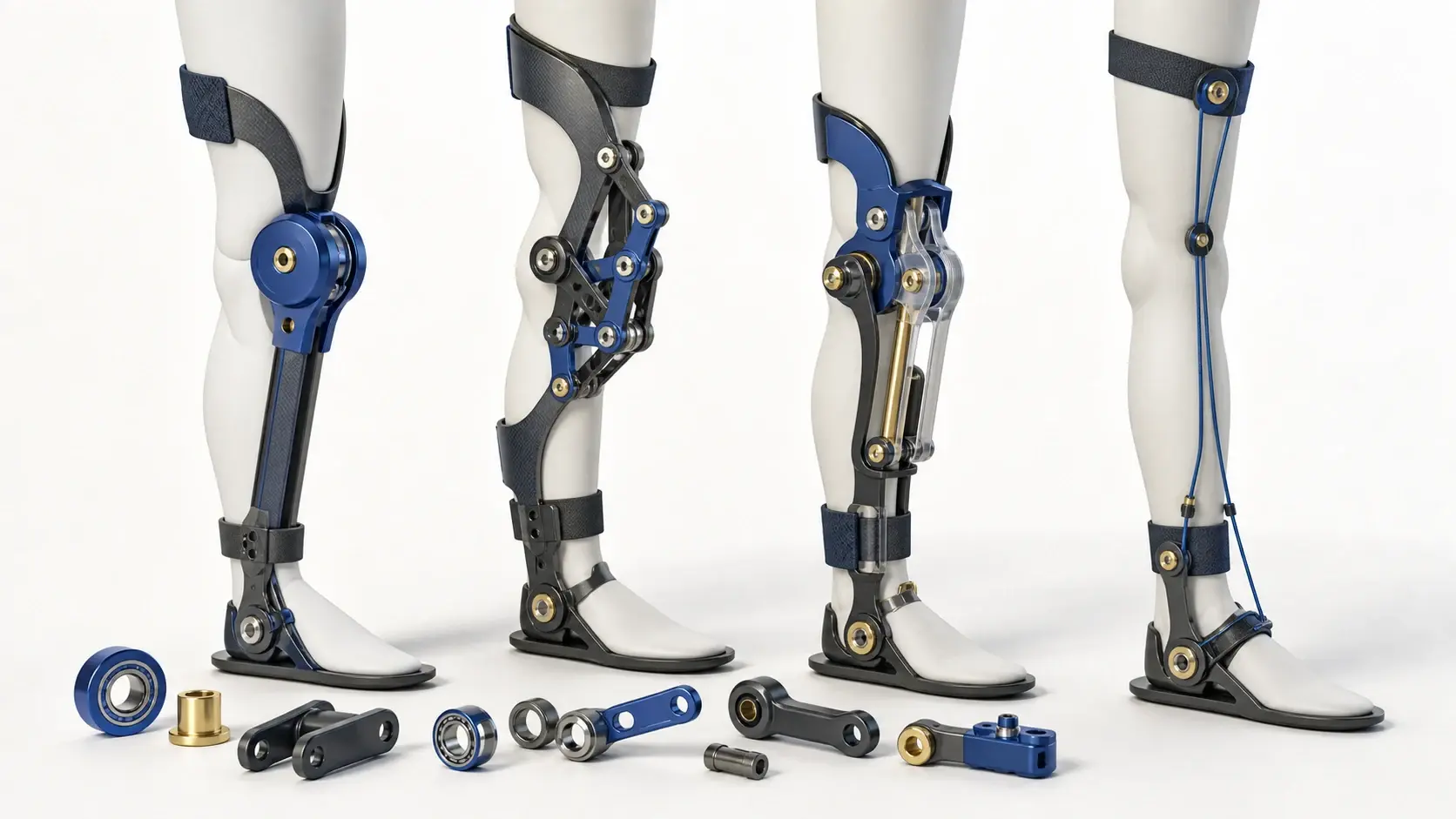
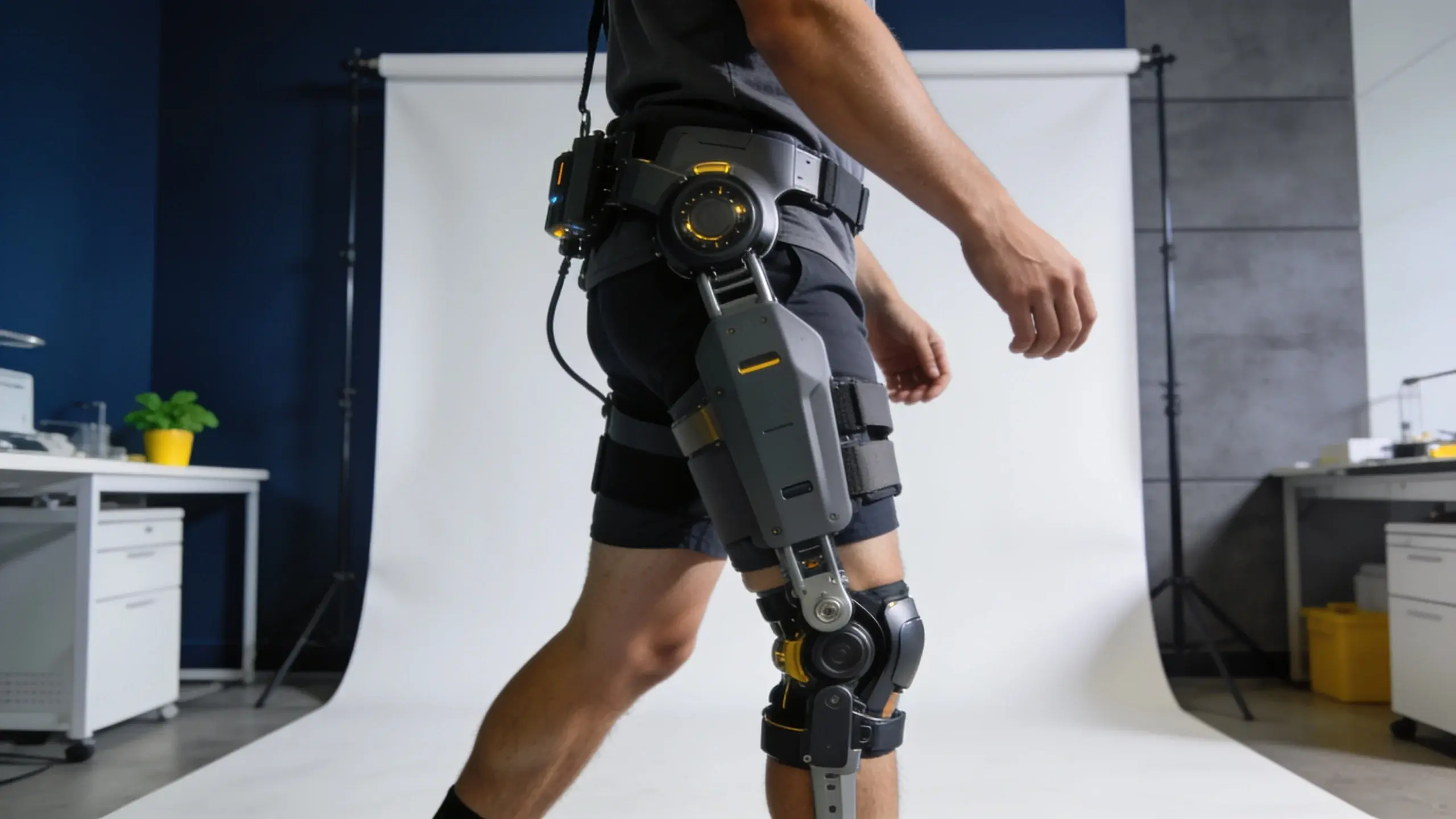
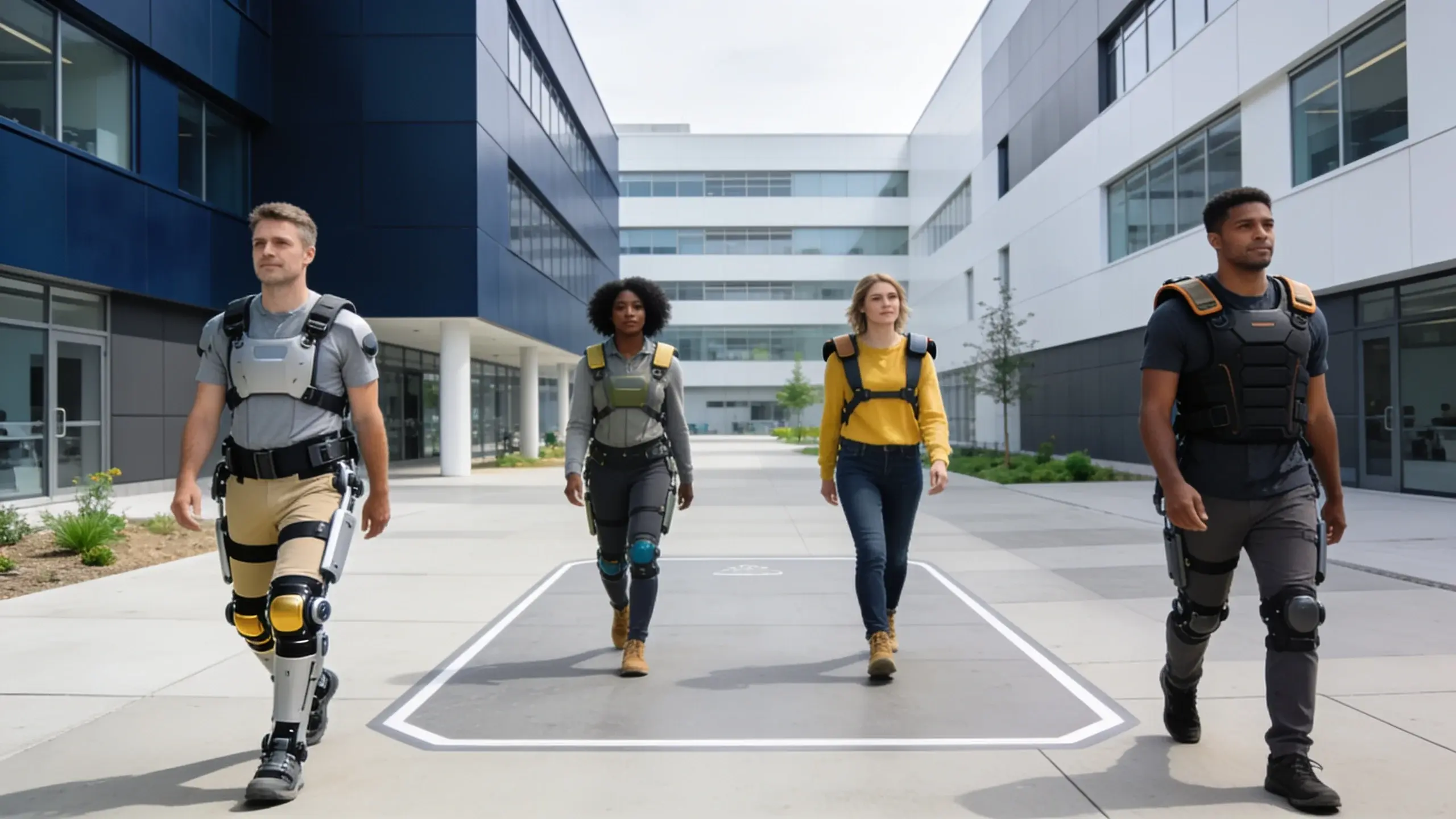
Ankle Exoskeletons: How Ankle Assistance Works
A research-led guide to ankle-assist direction, force paths, powered drives, soft exosuits, passive springs, sensing and study limits.

Research standard: this guide draws on primary records, technical documentation and documented field experience. Volatile facts such as price, availability and firmware are reviewed on a dated schedule.
Ankle exoskeleton describes a target, not one machine
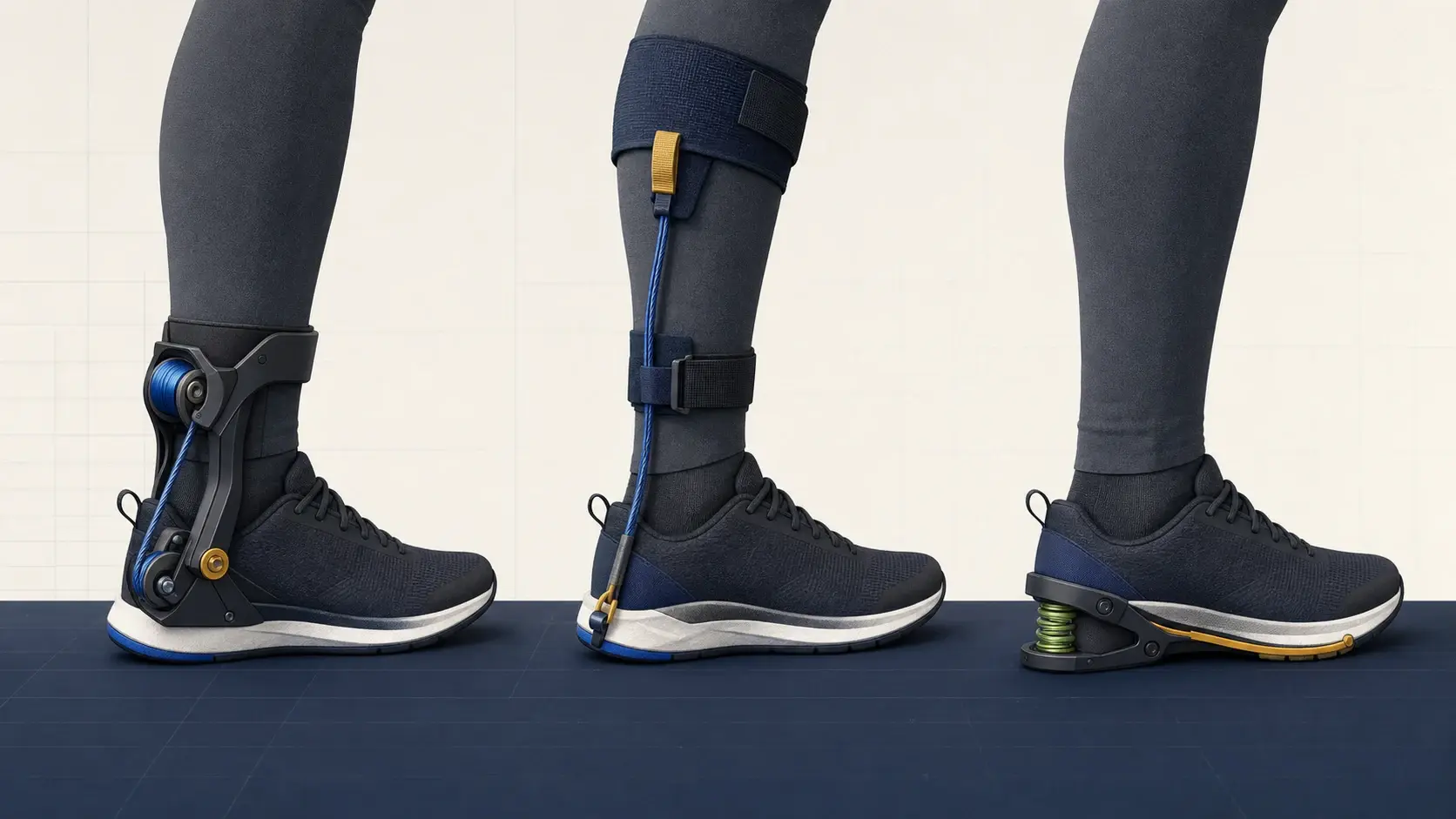
An ankle exoskeleton is a wearable mechanism that transfers force between the foot and lower leg so that an external moment acts around the ankle. That definition includes rigid frames with a mechanical hinge, soft exosuits that tension a cable between textile anchors, and unpowered systems that engage a spring during part of a stride. The assisted joint is shared; the structure, transmission and control can be entirely different.
The term also appears in laboratory equipment, portable research prototypes and multi-joint systems. A tethered emulator may keep the heavy actuator off the body and send force through a Bowden cable. An untethered system carries motors, electronics and a battery. A passive design has no motor at all. These categories should not be merged into a single performance range because their mass accounting, power source, movement constraints and experimental purpose differ.
This guide therefore owns the ankle-specific architecture question. The exoskeleton-joints guide explains degrees of freedom and alignment across the body. The powered-systems guide follows the complete sensing-to-actuation loop. The exoskeleton-types guide classifies whole systems. Here, the useful questions are narrower: which ankle direction is assisted, when is force applied, where does the reaction force return, and what exactly did a study test?
Plantarflexion and dorsiflexion are different assistance jobs
Plantarflexion points the foot downward relative to the shank. During walking research, plantarflexion assistance is commonly applied while the foot is on the ground and often increases toward late stance, when the ankle contributes to push-off. Dorsiflexion brings the top of the foot toward the shank. Devices that support dorsiflexion commonly act during swing or around foot placement. A design can support one direction, alternate between them or remain backdrivable while inactive.
Direction must be stated with phase and sign convention. A paper may call a spring a plantarflexor assist because its moment points toward plantarflexion, even though the spring first stretches while the ankle moves into dorsiflexion. Another system may actively pull the forefoot upward during swing. These are not contradictory descriptions: one describes the direction of the external moment, while the other describes joint motion at a particular time.
| Assistance field | Question to ask | Why it changes interpretation |
|---|---|---|
| Direction | Plantarflexion, dorsiflexion or both? | The directions perform different mechanical jobs |
| Stride phase | Stance, push-off, swing or transition? | The same moment can interact differently with changing joint motion |
| Laterality | Unilateral or bilateral? | Per-side hardware and results are not automatically system totals |
| Task | Level walking, incline, stairs or running? | A profile tuned for one task is not a universal ankle profile |
| Baseline | Normal shoes, device worn with zero torque, or another controller? | Each baseline includes a different hardware and mass condition |
| Measurement boundary | Motor current, cable force, device-joint torque or estimated biological moment? | These values cannot be substituted without a documented model |
Four ankle-assistance architectures
Powered rigid-frame systems
A rigid powered ankle exoskeleton typically connects a footplate or shoe to a shank structure through a revolute joint or another guided mechanism. A motor turns that mechanism directly or through gears, belts, drums, ropes or short cables. The frame carries structural loads, while the shoe and lower-leg interface close the force path through the wearer. Encoders, force sensors or strain gauges can measure motion and load near the device joint.
The 2022 Nature prototype is one documented example, not a category specification. It placed a brushless motor, drum and rope transmission on each lower leg, used a carbon-fibre and aluminium frame, and transferred forces through a shoe and calf strap. Strain gauges measured torque at the exoskeleton joint. This arrangement kept the transmission short but placed meaningful mass near the ankle, illustrating a real design trade-off rather than a universal solution.
Proximal motors with cable transmission
Another architecture carries motors and much of the supporting hardware near the waist, then routes force to the ankle through Bowden cables. The 2021 Journal of NeuroEngineering and Rehabilitation system used waist-mounted motors, interchangeable cables, cuffs and footplates. Its bilateral design could command plantarflexor torque during stance and constant dorsiflexor torque during swing. Moving actuation proximally changes mass distribution, but cable friction, routing, compliance and attachment motion become part of the controlled system.
A relocated actuator does not make the ankle assembly passive. The ankle still receives actively commanded force; only the source is carried elsewhere. Conversely, a motor mounted close to the ankle does not prove that measured motor output reaches the wearer unchanged. Transmission loss, frame deformation, joint geometry and body-interface motion sit between actuator output and biological response unless the study measures the relevant boundary directly.
Soft ankle exosuits
A soft exosuit replaces long rigid links with textile anchors, cables and garment structures. One common path anchors a cable housing at the calf and the inner cable near the heel or insole. Tension then creates a moment around the ankle without a rigid hinge beside it. The system still needs a stable load path: textile stretch, soft-tissue compression, anchor migration and cable routing all influence the relationship between commanded cable travel and delivered force.
Soft and rigid are therefore descriptions of structure, not power source or assisted direction. A soft system may use powered Bowden cables; a rigid system may use a passive spring. Some designs deliberately combine rigid foot components with compliant cuffs or garments. The most informative description names the foot anchor, shank anchor, transmission and actuator instead of relying on the word exosuit as if it specified the whole mechanism.
Unpowered spring-and-clutch systems
An unpowered ankle exoskeleton can store and return mechanical energy without a motor, battery or electronic controller. In the 2015 Nature study, a mechanical clutch engaged a spring while the foot was on the ground and disengaged it during swing. The spring acted in parallel with the calf muscles and Achilles tendon, while rigid foot and shank sections and a lever formed the wearable force path.
The timing mechanism is the key distinction. A permanently engaged stiff spring could resist motion during the wrong part of the stride. Clutching allows the system to build spring force during stance and release the foot for swing. A 2019 low-profile prototype moved the clutch under the foot and used a soft conformal shank interface, showing that a passive ankle system does not require one visible rigid hinge. Its case studies established prototype behavior, not a category-wide effect.
| Architecture | Energy and force source | Typical force path | Evidence fields that matter |
|---|---|---|---|
| Rigid powered | On-body motor through a local transmission | Foot or shoe → device joint/frame → shank interface | Joint axis, torque sensing, transmission ratio, distal mass |
| Cable-driven powered | Motor carried proximally; cable delivers force | Heel or insole anchor → cable → calf anchor or rigid cuff | Cable friction, routing, force sensing, proximal and distal mass |
| Soft exosuit | Usually powered cable tension, sometimes elastic elements | Textile or semi-rigid foot anchor → cable/strap → calf or waist garment | Anchor deformation, human-suit stiffness, measured cable force |
| Unpowered spring-clutch | Energy stored from the wearer's movement | Foot clutch/lever → spring → shank frame or garment | Spring stiffness, engagement timing, residual swing resistance |
The foot and shank interfaces complete the mechanism
An actuator cannot create an ankle moment through one contact point. It needs separated reaction points, usually one on or under the foot and another on the lower leg. Their spacing creates a lever arm. The shoe, insole, heel attachment, footplate, calf strap and cuff are therefore functional components, not packaging around the robot. If either interface shifts, the relationship between device motion and body motion changes.
Rigid designs can place a bearing near an estimated ankle axis, yet the biological ankle is not a perfect single-axis hinge. Soft designs avoid a rigid axis but introduce distributed deformation. A 2024 IEEE BioRob ankle module aligned a quasi-direct-drive actuator coaxially with the ankle and used a boot plus orthosis components for the body interface. The authors also estimated ankle angle from separate foot and shank inertial sensors because compliance made the motor encoder an incomplete proxy for body-joint motion.
This is why fit-independent comparisons are weak even when no fit advice is being offered. Studies should report component sizes, attachment locations, lever arms and how joint motion or torque was measured. A device-joint angle, a motor angle and the angle between the wearer's foot and shank are related measurements, but they are not automatically identical.
Sensors and controllers decide when powered assistance appears
Powered ankle systems commonly combine joint encoders, pressure-sensitive insoles, foot switches, inertial sensors, load cells or strain gauges. These signals estimate events such as heel strike, stance, toe-off and swing; measure the assistance path; and provide feedback to a low-level controller. The selected sensors depend on the architecture and research question. No single sensor list defines an ankle exoskeleton.
A controller then specifies a desired torque or force profile. Parameters can include onset, peak timing, peak magnitude and fall time. The 2022 Nature study adjusted assistance using data collected during short bouts of walking at varying speeds, while the 2025 Communications Engineering study tested a rapid interaction-based optimization method on ankle hardware. Both show that assistance is a tunable time history, not one fixed torque number. Their optimization objectives and test protocols remain study-specific.
Backdrivability and zero-torque modes need careful reading. Backdrivability describes how readily the mechanism can be moved from its output side; it does not mean zero resistance in every condition. A zero-torque controller actively tries to reduce device torque while the participant still carries and moves the hardware. Normal-shoe walking removes that hardware. Comparing an assisted condition with each baseline answers a different question.
What the research examples actually establish
Ankle-exoskeleton papers often report metabolic power, muscle activity, joint mechanics or controller tracking. Those outcomes should stay attached to the participant group, movement, speed, hardware and comparison condition. A result from level treadmill walking does not automatically transfer to slopes or running. A unilateral tethered end-effector is not equivalent to a bilateral portable system. A benchtop torque rating is not a human-performance result.
| Primary study | Architecture and protocol | Narrow lesson for comparison |
|---|---|---|
| Collins et al., Nature (2015) | Bilateral unpowered clutch-and-spring devices; nine participants walking on a treadmill | Passive timing and spring stiffness are active design variables even without a motor |
| Witte et al., Science Robotics (2020) | Powered and unpowered ankle assistance evaluated during running | A profile or elastic strategy that works for walking should not be assumed to transfer to running |
| Orekhov et al., JNER (2021) | Portable bilateral cable-driven system with waist motors; plantarflexion and dorsiflexion modes | Actuation location, direction and task belong in the same architecture record |
| Slade et al., Nature (2022) | Portable bilateral rigid-frame system personalized during naturalistic walking | Joint torque, control parameters, per-ankle mass and the comparison baseline were explicitly bounded |
| Zhao et al., IEEE BioRob (2024) | Unilateral modular quasi-direct-drive prototype; benchtop tests and one-person task circuit | Bidirectional capability and backdrivability can be characterized without implying population-wide outcomes |
| Chen et al., Communications Engineering (2025) | Primarily tethered ankle testbeds with participant-specific torque optimization | Optimized profiles differed across participants and depended on the selected objective and hardware |
A practical evidence checklist
- Name the assisted direction and the part of the stride in which assistance is commanded or engaged.
- Separate rigid frame, soft anchor, actuator, transmission, sensor and body-interface components.
- Record whether the actuator is on the ankle, carried proximally or located off-board.
- Distinguish unilateral, per-ankle and bilateral system measurements.
- Keep peak torque, normalized torque, positive work and controller tracking error as separate fields.
- State the task, speed, terrain, participant count and comparison baseline beside every outcome.
- Treat prototype specifications and study results as evidence for that setup, not as a market-wide range.
This checklist prevents a common shortcut: comparing the largest number in one paper with the headline outcome in another. A high peak torque may be required for one timing profile but irrelevant to another. A lighter end-effector may depend on an off-board actuator omitted from the wearable mass. A passive system may report no electrical input while still altering joint mechanics through spring force. Comparable records preserve every boundary.
Sources
- Nature: unpowered clutch-and-spring ankle exoskeleton (2015)
- IEEE Transactions on Neural Systems and Rehabilitation Engineering: low-profile unpowered ankle exoskeleton (2019)
- Science Robotics: powered and unpowered ankle assistance during running (2020)
- Journal of NeuroEngineering and Rehabilitation: configurable ankle-exoskeleton mass (2021)
- Nature: portable rigid-frame ankle exoskeleton (2022)
- IEEE BioRob: modular backdrivable ankle exoskeleton (2024)
- Communications Engineering: rapid ankle-assistance optimization (2025)
Continue your research
Key facts
- Ankle assistance is defined by the external moment around the ankle, not by one fixed device shape.
- Plantarflexion and dorsiflexion assistance act in different directions and commonly target different parts of a stride.
- Rigid frames, cable-driven exosuits and passive spring-clutch systems can all create ankle assistance through different load paths.
- A powered device may carry its motor at the ankle or relocate actuation toward the waist and transmit force through cables.
- Torque magnitude, timing, task, baseline and body interfaces must match before two ankle-exoskeleton studies can be compared.
Frequently asked questions
What does an ankle exoskeleton do?
It creates, stores or redirects a moment around the ankle through separated contacts on the foot and lower leg. The exact action depends on direction, timing, architecture, transmission and controller.
What is the difference between plantarflexion and dorsiflexion assistance?
Plantarflexion assistance points the foot downward relative to the shank and is commonly studied during stance and push-off. Dorsiflexion assistance brings the foot toward the shank and is commonly studied during swing. A device may support one direction or both.
Can an ankle exoskeleton work without a motor?
Yes. Unpowered designs can use a clutch and spring to store energy during one part of a stride and return it later. Their behavior still depends on spring stiffness, engagement timing, interfaces and the movement being performed.
Is an ankle exosuit the same as a rigid ankle exoskeleton?
Both can apply an external moment around the ankle, but their force paths differ. An exosuit usually relies on textile anchors and cables, while a rigid design uses structural links and often a mechanical joint. Power source and assistance direction must still be stated separately.