Exoskeleton Weight: How to Compare It Correctly
Separate total, per-side, operational and component mass before comparing wearable robots across unlike configurations.

Research standard: this guide draws on primary records, technical documentation and documented field experience. Volatile facts such as price, availability and firmware are reviewed on a dated schedule.
The short answer: weight is a bundle of measurements
The question “How much does an exoskeleton weigh?” sounds as if it should produce one category-wide number. It cannot. Exoskeleton describes systems as different as a small passive spring assembly, a bilateral powered ankle platform and a multi-joint frame. Even two papers describing similar body regions may count components differently. The useful answer is therefore a measurement record, not a range assembled from unlike headlines.
Start with the system boundary. Ask which physical parts were on the person during the reported configuration and which remained off-body, optional or external. Then identify laterality, body location, size and operating state. Only figures with compatible answers can be placed in the same comparison column.
Technical papers often use weight in prose while reporting kilograms. Kilograms measure mass; weight is a force. This guide retains the familiar search phrase exoskeleton weight, but comparison tables should label the field as mass in kilograms and preserve the source’s original scope.
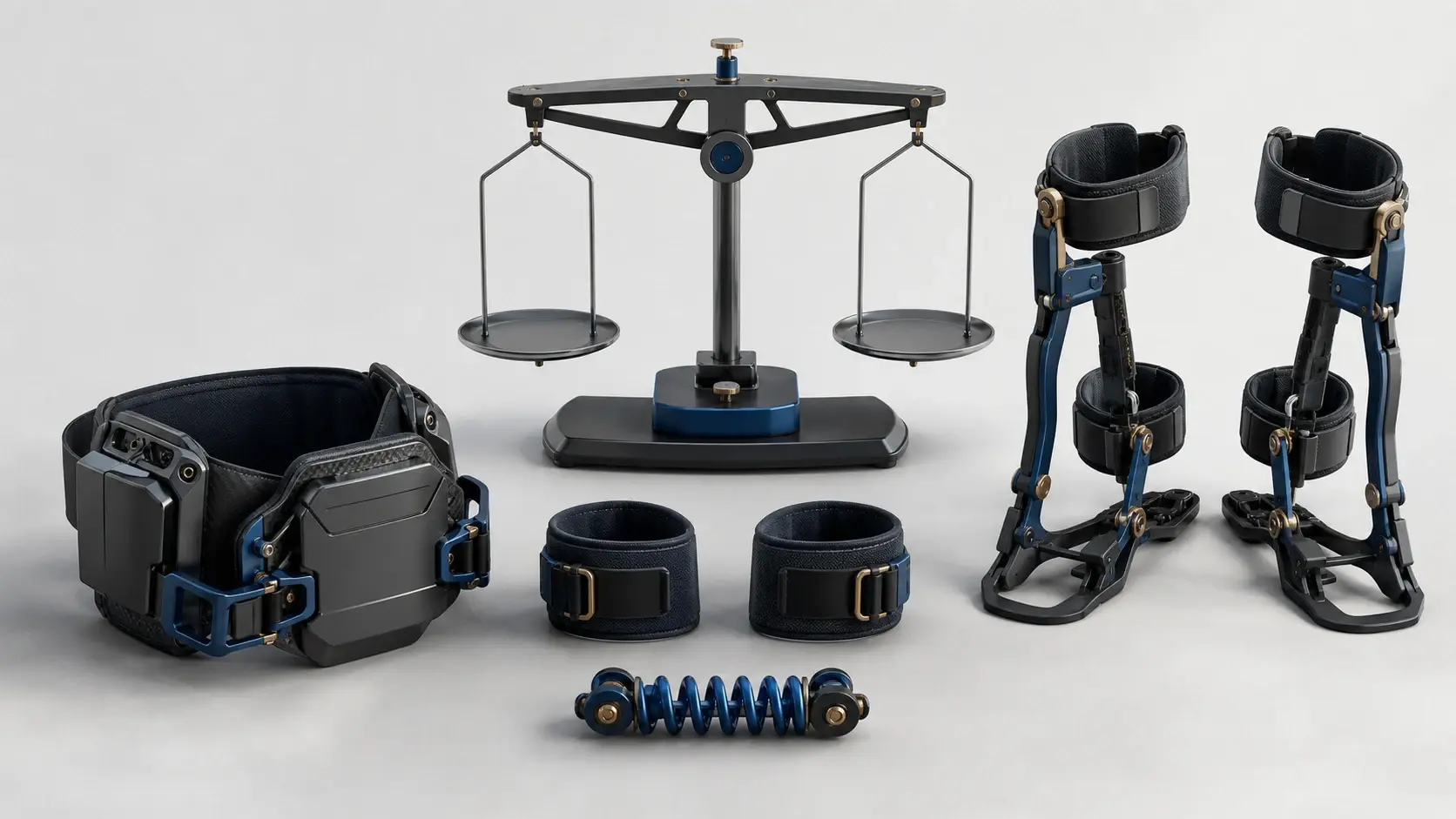
Six mass fields that should not be merged
The fields below describe different boundaries. A source may publish several of them, but one should never be substituted for another without an explicit calculation and complete component list.
| Mass field | What it should include | Main comparison trap |
|---|---|---|
| Total operational mass | Every device component used in the stated operating configuration | Leaving out the battery, controller, footwear or a remote module |
| Bilateral system mass | Components worn on both sides plus shared modules | Comparing it with a figure reported per leg or per joint |
| Per-side mass | One complete left or right assembly under a stated configuration | Doubling a number that already includes shared waist hardware |
| Distal mass | Mass placed farther from the torso, such as at the shank, ankle or foot | Treating it as interchangeable with the same mass at the waist |
| Shared or proximal mass | Waist, pelvis or torso modules serving both sides | Adding the shared module once per side |
| Component mass | A named motor, frame, battery, cuff, spring or other part | Presenting the lightest part as the mass of the complete system |
Operational must also be defined. For a powered untethered system, the operating boundary normally includes its portable energy source and onboard control hardware. A tethered laboratory system may move motors, power supplies or computers off the body. Those two arrangements can answer valuable research questions, but their worn mass figures do not describe the same object.
Why mass location belongs beside total mass
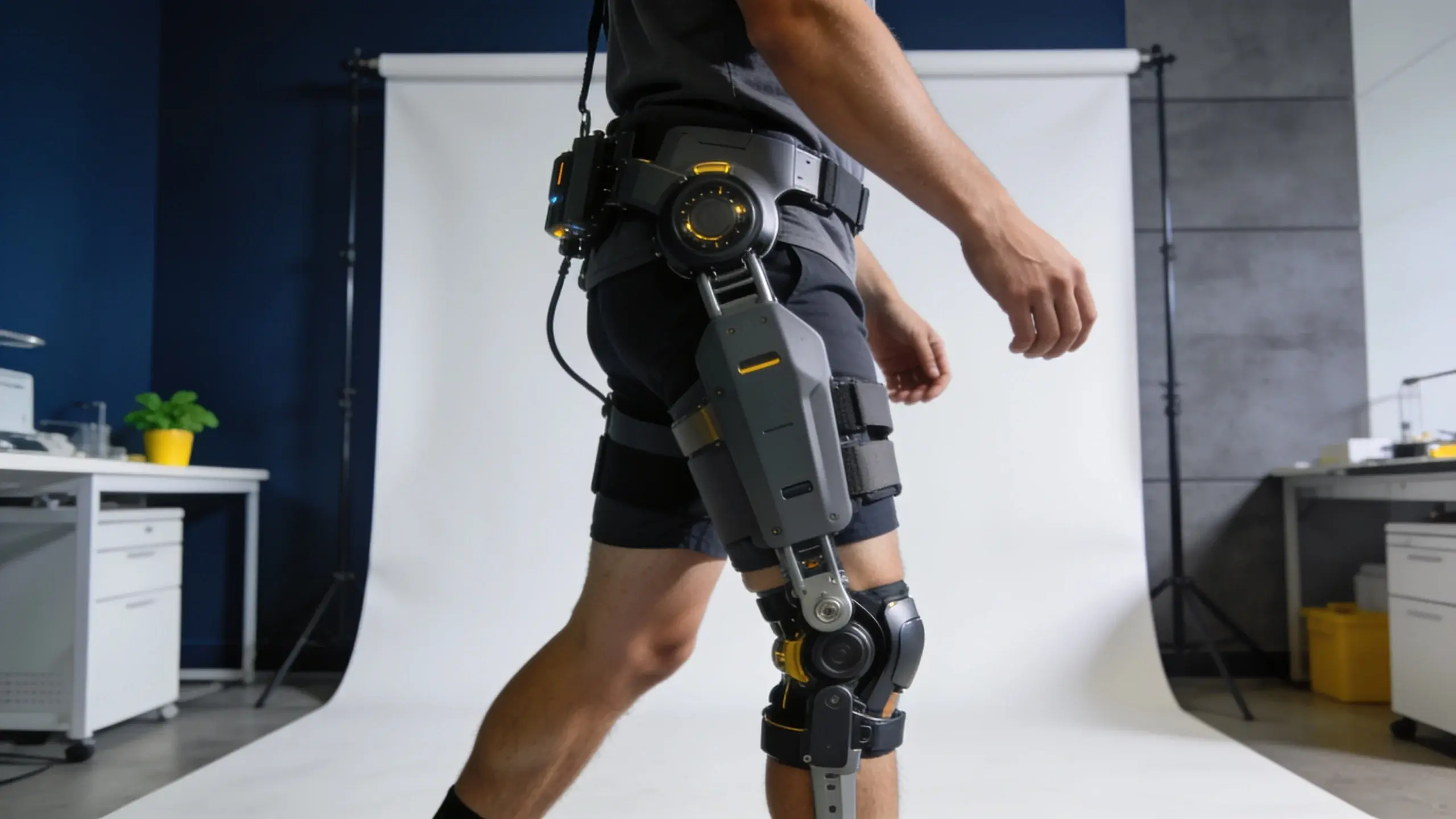
Total mass tells you how much material the person carries, but it does not describe where that material moves. A module near the waist travels differently from a component fixed near the foot. Frame geometry, joint motion and the distance from the body’s center all change how added mass participates in movement. That is why serious device papers often report both a total and a component-by-location breakdown.
Browning and colleagues isolated this question in a controlled 2007 experiment. Five adult men walked while researchers applied defined loads at the waist, thighs, shanks and feet. The study used several load magnitudes at each location and measured energetic and biomechanical responses. It does not provide a universal conversion factor for every person or exoskeleton. It does show why the location field cannot be discarded when interpreting a wearable device’s total.
Location also interacts with architecture. Moving a motor toward the torso can reduce the hardware attached lower on the leg, but it may require a cable or other transmission to reach the assisted joint. Keeping an actuator near the joint can simplify that transmission while placing more mass farther from the torso. Neither arrangement wins from the mass figure alone; the comparison needs the complete device and task.
Four primary-source examples with different boundaries
These examples are research platforms, not a product comparison. Their assisted joints, structures, power sources and experiments differ. The point is to see how the authors define the mass field before anyone attempts to align the figures.
| Primary source | Reported mass boundary | What the wording teaches |
|---|---|---|
| Slade et al., Nature (2022) | 1.2 kg for each ankle exoskeleton; a 0.3 kg battery is also reported | Per-ankle and shared battery figures must remain visibly separate unless a total is explicitly reconstructed |
| Ye et al., Micromachines (2021) | 2.24 kg for the whole soft-exoskeleton system; 62% located at the waist | A total becomes more useful when a component table and body locations are supplied |
| Orekhov et al., JNER (2021) | 2.4–2.6 kg bilateral total depending on cable length, footplate and cuff size | One platform can have a legitimate mass range because the fitted configuration changes |
| Zhou et al., Sensors (2022) | 550 g total for an unpowered hip–knee assembly, with waist frame, springs and shank frames itemized | Passive and powered systems can have radically different component boundaries and should not be treated as peers |
The Nature paper is especially useful as a reading exercise. It says the untethered system used an exoskeleton on each ankle and a battery pack at the waist, then reports 1.2 kg per ankle and 0.3 kg for the battery. A comparison table should preserve both statements. Calling the device simply 1.2 kg loses laterality and the shared energy source; calling it 2.7 kg is a derived sum that should be labeled as such rather than presented as the paper’s own headline figure.
The configurable ankle platform makes a different reporting choice. Its authors give a bilateral range because cable length and the sizes of footplates and cuffs vary. The accompanying table states that values are per leg except for the waist assembly. This small note prevents two common errors: counting the shared module twice and treating a medium-size configuration as a universal exact value.
What may be inside or outside the number
Before copying any kilogram figure, trace the hardware list in the methods, figure caption or supplement. A complete record states whether each item below is included, excluded, optional or not reported.
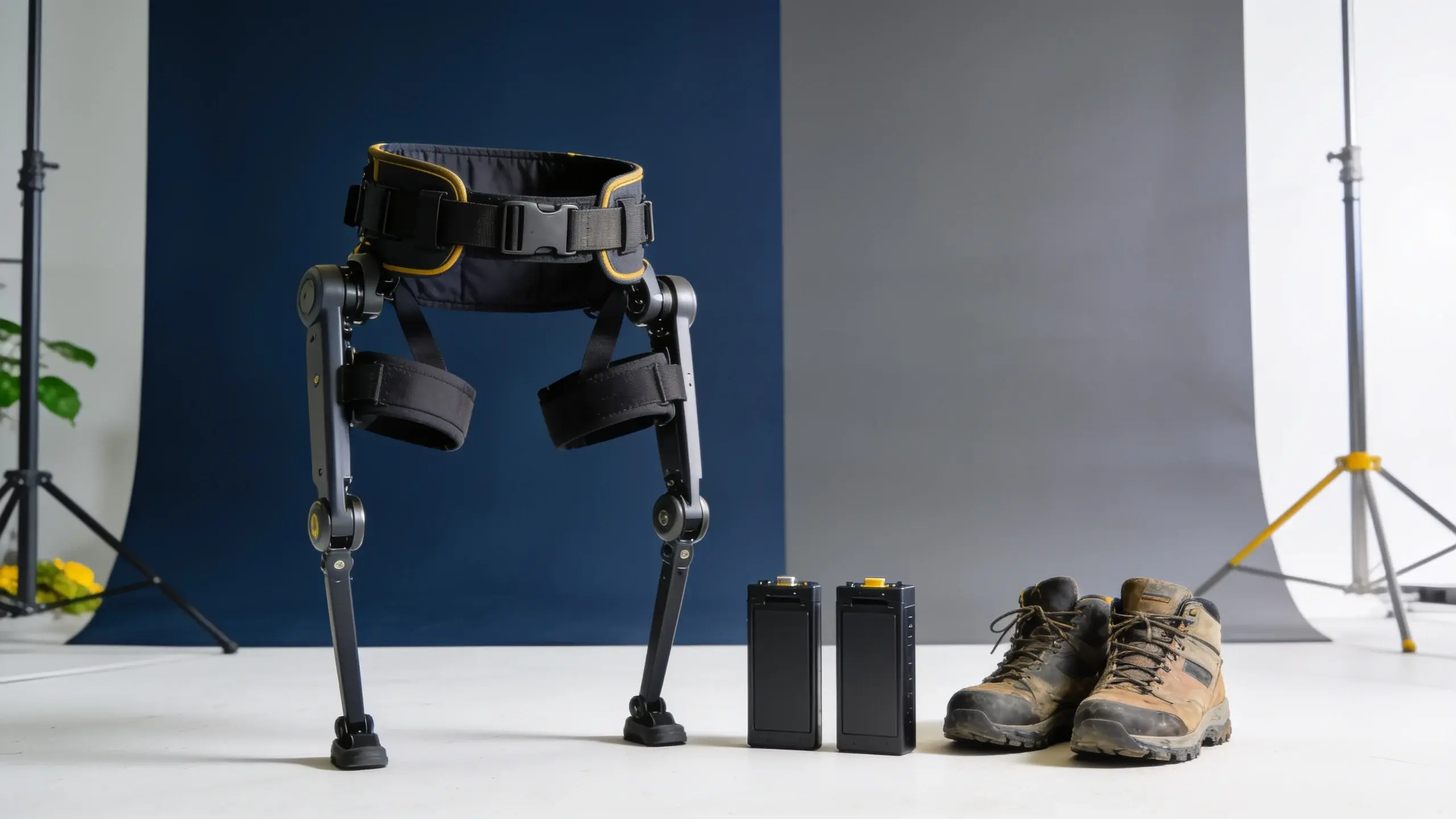
- Left and right frames, braces, footplates or textile structures.
- Motors, springs, transmissions, cables, drums and gearboxes.
- Battery packs, motor drivers, embedded computers and sensor electronics.
- Belts, cuffs, straps, padding, insoles, shoes or other required interfaces.
- Wiring, enclosures and mounting hardware rather than idealized bare components.
- Optional modules, alternate batteries, size-dependent pieces and task-specific attachments.
- Off-body equipment used by a tethered laboratory setup.
Items outside the operating configuration, such as a charger, shipping case or spare battery, belong in a portability or package-weight field rather than total operational mass. Conversely, a required waist battery cannot disappear merely because the source lists it in a different paragraph from the leg assemblies.
Configuration changes the answer
A trustworthy mass figure names the exact configuration. Bilateral and unilateral setups differ. A larger cuff or footplate may add material. A higher-capacity battery, second actuator, alternate spring or additional sensor can change the total. Research teams also revise prototypes between papers, so a number from one publication should not migrate to another generation just because the project name is similar.
The operating state matters as well. A paper may compare normal clothing with an unpowered device, a zero-torque powered device and an assisted device. The hardware mass may remain constant across the device conditions, but the comparison baseline changes. Report the physical configuration and the experimental condition separately; powered off, zero torque and no device are not synonyms.
Size ranges need the same discipline. If authors provide 2.4–2.6 kg because fitted hardware varies, retain the range and the named causes. Selecting only the lower endpoint makes the record look more precise while erasing the configuration that created the upper endpoint.
A seven-step comparison method
- Identify the exact device or research prototype and publication version.
- Record powered or passive architecture and whether the setup is tethered or untethered.
- Write the system boundary in plain language before copying the number.
- Mark total, bilateral, per-side, shared and component figures in separate fields.
- List included energy, control and body-interface hardware.
- Record body location and configuration variables such as size, side count and battery option.
- Compare only compatible fields; otherwise show the figures side by side with their limitations.
A normalized row might read: “2.4–2.6 kg, bilateral untethered research system; shared 1.37 kg waist assembly; remaining values reported per leg; range depends on cable, footplate and cuff size.” That row is longer than “2.4 kg,” but it preserves the information needed to understand the device.
How to audit a research paper
Begin in the methods rather than the abstract. Search for mass, weight, component, battery, waist, per leg and bilateral. Then read the figure caption and table footnotes. The most important boundary note may appear under a component diagram rather than in the results. If a paper provides computer-aided-design files or a bill of materials, treat those as supporting records while keeping the publication’s stated assembled mass as the primary headline.
Next, reconcile the prose with the table. Component rows should add to the stated total once quantities and shared modules are handled correctly. If they do not, do not silently repair the paper. Record the apparent mismatch, check supplementary material and label any arithmetic as an independent calculation.
Finally, separate the mass measurement from the study outcome. A controlled result belongs to the exact participants, hardware, settings, activity and comparison condition in that paper. The device mass helps describe the setup; it does not allow the result to be transferred to a different exoskeleton with a similar number on the scale.
Common comparison errors
- Putting per-leg, bilateral and whole-system numbers in one column.
- Omitting a shared waist pack or counting it once for every leg.
- Comparing a tethered worn assembly with a fully untethered operational system.
- Using bare-frame or actuator mass as if it included interfaces and energy storage.
- Applying one prototype generation’s mass to another generation or product family.
- Dropping the upper end of a size-dependent range.
- Turning a low mass figure into a claim about comfort, assistance or overall quality.
What exoskeleton weight can and cannot tell you
Mass is a necessary design and comparison field. It helps reveal how much hardware is worn, where engineers place actuators and energy storage, and whether two reported configurations have the same boundary. A detailed breakdown can also expose why a total changes across sizes or variants.
Mass is not a standalone performance score. A lighter system may deliver a different magnitude or direction of assistance, omit hardware carried by another setup, or use a structure intended for a different task. A heavier system may place more of its mass near the torso or include components excluded elsewhere. Compare mass alongside assisted joint, architecture, control, output measurement, interface and experiment—not instead of them.
The most useful published number is therefore not always the smallest. It is the number with the clearest boundary: exact configuration, all required components, laterality, location, size and verification source. When those details are missing, “not verified” is more accurate than a clean but misleading total.
Sources
- ASTM F3323-24: Standard Terminology for Exoskeletons and Exosuits
- Medicine & Science in Sports & Exercise: effects of added mass location (2007)
- Nature: portable rigid-frame ankle exoskeleton (2022)
- Micromachines: mass distribution of a multi-joint soft exoskeleton (2021)
- Journal of NeuroEngineering and Rehabilitation: configurable ankle-exoskeleton mass (2021)
- Sensors: component mass of an unpowered hip–knee exoskeleton (2022)
Continue your research
Key facts
- A per-ankle figure is not a bilateral system total.
- Battery, electronics, footwear, cuffs and optional modules may sit inside or outside a published mass figure.
- Mass location matters: waist-mounted and lower-leg mass are not mechanically interchangeable.
- Sizing and component choices can create a mass range for the same research platform.
- Lower mass is a design attribute, not a complete evaluation of assistance or usability.
Frequently asked questions
How much does an exoskeleton weigh?
There is no useful category-wide figure. Research examples range from sub-kilogram passive assemblies to multi-kilogram powered systems, but those numbers cover different joints, sides, components and configurations. Check the exact system boundary before comparing them.
Does exoskeleton weight include the battery?
Sometimes, but not always in the same field. A paper may include the battery in total operational mass or list a shared waist battery separately from per-leg assemblies. Read the methods and component table rather than assuming.
Is per-leg weight the same as total wearing weight?
No. A per-leg figure covers one side and may exclude shared hardware. Total wearing mass needs both sides plus any waist, torso, battery, controller or other required modules, with shared items counted once.
Is a lighter exoskeleton automatically better?
No. Lower mass can be useful, but it does not establish assistance, fit, control quality or suitability. Compare compatible mass boundaries alongside the device’s architecture, assisted joint, interface and evidence.